Tag Archives: VC Community

Nebraska Keynote Links

Greetings to my Nebraska ESUPDO audience. Here are a collection of links and resources mentioned in my presentations.

Breakout Session

Collaborations Around the Planet

Read Around the Planet

Information for Collaborations

Content Providers

Keynote Presentation

More Information

Submit for Video Champions Award by Feb. 13

Did you know TANDBERG is running a Video Champions Award?

The Video Champion Awards will honor organizations that are demonstrating positive impact and influence in video communications. Entrants will be awarded for innovations that break through conventional processes and highlight new ways of using video communications to help organizations, teams or individuals achieve their goals.

Hurry and apply!

eTech Conference, OH

Greetings eTech Conference participants! Here are the links and resources mentioned in my session today.

Collaborations Around the Planet

Read Around the Planet

Information for Collaborations

More Information

Day 20: Just Do It

20 Days to Being a Better VC CoordinatorNow we have come the the last day of our challenge. We hope that you have learned some tips to help you coordinate videoconferencing within your building and assist your teachers.

Our last challenge to you is “Just Do It”. Many times we find that people wait until every little detail is perfect until they begin to try to use the technology. Once you know that your equipment is operational, get started doing something. Find a teacher that is curious and adventurous and ask what he or she is teaching during the spring semester and find a connection that fits into their curriculum. Before you know it, you will have active videoconference participation.

We have heard from several of you that you have enjoyed reading along with us this month. Let us know if we have missed things or if there are other topics that you would like us to address. We have learned much about collaboration during this blogging adventure and hope that you have learned along with us.

Comment Leave us a note about what you learned or how you plan on using this information. If you are a “first time commenter”, click the link that says Comments and post your thoughts for us.

How to comment on my blog:

janine-blog

How to comment on Roxanne’s blog:

comment-on-rox

May the connection begin on time.
May the batteries in the remote not run down.
May the video move fluidly and the audio be a robust sound.
Here’s wishing you many quality curriculum connections in the months to come.

All the best,
Janine and Roxanne

Day 19: Now, Participate in Megaconference Jr.

20 Days to Being a Better VC Coordinator

Now that you’ve been through this little training experience, it’s time to join the global learning community!

Megaconference Jr. is one of THE videoconferencing events of the year for K12 videoconferencing. It’s a 12 hour videoconference, facilitated by students, with student presenters featured. An incredible global experience, a chance for networking with other schools, and an opportunity for learning what other schools are doing with VC.

What to Expect on February 19, 2009

Because this is a large videoconference with many sites participating, it’s quite different than point to point experiences. So make sure you come into the experience with appropriate expectations.

  • You will see 30 minute sessions on all kinds of content and topic areas. The presentations come from elementary, middle, and high school students.
  • You will see a variety of presentations styles and tools. Some you’ll learn best practices; others you’ll have ideas on how to improve the presentation. Take it as a learning experience for everyone.
  • You will NOT have perfect audio and video. You should lower your expectations for the video quality.  This is partly due to the huge number of sites connecting and the variety of bandwidth capacity represented.
  • Megaconference increases the opportunities for global education. So INCREASE your expectations for global learning, and increase your patience and tolerance for international connections.
  • You will also see that some participating sites are new to VC and don’t know how to behave. i.e. MUTE your microphone in a multipoint. Take it as a learning lesson of what not to do. And make sure you are MUTED unless you’ve been called on to ask a question or interact.

Make the Most of Your Participation

  • Set up Megaconference in your library and have different classes come in and out throughout the day as they have time. Take the schedule and share it with your teachers. But warn them to be flexible because sometimes Megaconference gets off schedule due to the realtime nature of the event.
  • Make it an event to showcase the possibilities. Invite teachers and administrators to view.
  • Offer refreshments.
  • Have prizes. Make a geography game of it. Who can identify the location of the presenting site?
  • Hang up a large world map and have students mark the locations of the sites presenting throughout the day. Print the participants list (after registration closes) and have students find and mark the participating sites on the map.
  • If you’re not an interactive site, pretend that you are. Have the students answer the questions (but stay muted!).

Registration Choices

  • You can sign up to be a view only or “not interacting” site. Some schools prefer this for getting their feet wet.
  • Or you can sign up to be an interactive site. 3 schools get to interact in each session. The interactive spots go quickly, so hurry if you want to do this.

Comment Challenge

  • So, take a moment now to sign up! (If you usually register for VCs through someone else, you may want to check with them first on how you should register.)
  • If you have a story or suggestion for participating in Megaconference Jr., please comment and share!

Day 18: Uh Oh, It Doesn't Work!

20 Days to Being a Better VC Coordinator

One of the scariest things about videoconferencing is when it doesn’t work and you have a classroom of students waiting. Yesterday Roxanne gave you some great tips for accessing your lifelines. Today, we’ll examine the most common problems in a videoconference and give you tips for solving them. This is actually part of a training that I conduct for my coordinators, and we try to simulate each problem during the training.

First, there are four parts to a successful videoconference: sending video, receiving video, sending audio, and receiving audio. Most of the common problems related to one of these four parts.

The solutions under each problem are listed in order. The top ones are the most common solutions to the problem.

TV is Black / I Can’t See / I See Black / I See Blue

  • Check the TV/monitor/projector. Is it on and is it connected correctly? Some of my coordinators keep a picture or drawing of how all the cables are supposed to be connected.
  • Check the monitor. Is it on the right channel? Make a note for yourself on which channel it should be.
  • If you were able to see the dialing screen/menu before you connect, then it’s not your TV/monitor/projector. A blue or black screen is often a firewall problem on either end of the call. Try one of these test numbers to make sure you can connect outside your district on your own. Have the other site try connecting somewhere else too. If you can both connect to other places but not to each other, it’s probably a firewall problem. If you have access to someone with a bridge/MCU, ask them for help (usually at your educational service agency).
  • Once in a while the flat screen TVs won’t cooperate. If so, unplug the power, wait, plug it in.

Audio: I Can’t Hear

  • Check your TV/monitor volume. Check your videoconference system’s volume too. Both should be about in the middle (if your system uses both).
  • Have the other side check their microphone. If you see a Far End Mute icon, you know their microphone is muted. (This only shows up in point-to-point calls). Ask them to unmute. Tell them you can’t hear. Have them nod their head or wave if they can hear you.

Audio: They Can’t Hear Me

  • Check your microphone. Are you muted? Check your screen – usually you’ll see an icon if it is muted. Or Polycom microphones are muted when the light on it is red. Unmute so the far site can hear you.
  • Their TV volume might be turned down. You may have to write them notes on a sign to hold up in front of the camera or write on paper under the document camera. (Or call them on the phone.)

They Can’t See Me

  • Have them check their monitor/projector/TV. Is it on & on the right channel?
  • It may be a firewall problem on their end. See “I Can’t See” above. Have them try connecting to the one of these test numbers. They should determine if they get a picture and then call you back again and report. If they can’t see a picture on your system or the test site, they should talk to their tech person. If you can both connect to other places but not to each other, it’s probably a firewall problem. If you have access to someone with a bridge/MCU, ask them for help (usually at your educational service agency).

Call Rejected or Busy Signal or Call Rings & Rings

  • If you call and get a “call rejected” error, usually the other person is already in a call.
  • If the call rings & rings, usually something in the network between you & the other site is not allowing the call to negotiate. Both sides should try a test site. If your test call just rings & rings, then it’s not connecting through firewalls. If you have access to someone with a bridge/MCU, ask them for help (usually at your educational service agency).

Alerts: What Do They Mean?

  • IP Network: If this is down, then you don’t have a live Internet connection. Try another Ethernet jack in the room. Using a spot where a computer was connected and working usually guarantees a good connection.

When All Else Fails, Reboot or Redial

  • If you have a lot of connection problems, sometimes redialing will help clear it up.
  • If nothing is working, reboot the camera. Turn the camera off (reach up!!), wait, turn it back on.

Polycom Specific: “Flippy-Do-Button”

My schools all have Polycom endpoints, and another common problem is when you accidentally get yourself in the big screen and the far site in the picture-in-picture. How do you switch it back?

This happens with the button that I call the “flippy-do-button”. I’m sure there’s a more technical term! 🙂 On a VSX7000, if you press the Camera button while you are in a call, you’ll see an icon with two arrows pointing around. If you select it, you’ll swap the far and near pictures. It’s easy to change it accidentally by pressing the camera button and then 1 or the enter key. To get it back, just press Camera, 1. Whew!

Comment Challenge

  • Take this Word file with basically the same information presented here. Fill it in with your favorite test site number and your videoconferencing support number. Add the channel for your TV/monitor (if applicable). Then tape it to your videoconferencing cart in a prominent location.
  • Please comment and add any other troubleshooting tips you have.

"A Collaboration Nation"

In an “open letter to our government leaders,” Wainhouse Research recommends that the United States aim to be a “collaboration nation.”

The impact of turning the United States (or any other country) into an e-nation with an extensive telecommuting program could be sensational in turns of its high return, low cost, low risk, and immediate effect. Replacing 20M automobiles (a fraction of what is on the road today) with hybrids would cost approximately $500 billion while the investments to enable 20M telecommuters would be on the order of $2.5B. Taking 20M cars off the roads on a daily basis would save on emissions while also lightening the load on our nation’s highways.

A federal-government lead effort to become a “collaboration nation” should go a long way towards ridding our dependence on foreign oil and liberating our foreign policy, improving the environment, and helping the United States regain its leadership position in the global economy.

Read more here. What do you think? Visionary? Extravagant? Crazy? Are we too stuck on face to face communication? What do YOU think? Please comment….

Day 15: Kid Producers

20 Days to Being a Better VC CoordinatorHow much do you let students help you with videoconferences? For this challenge, let’s think about some appropriate ways to involve students in the production of the videoconference.

Microphone

One of the most simple ways to involve students is to have them in charge of muting the microphone. I’ve seen this work well in a couple of ways (about 2nd grade and up):

  • A trusted student is responsible for muting and unmuting in a multi-point conference such as an ASK program or an interview with an expert.
  • OR, as each student comes up to the microphone, they press the button on the microphone, state their question or comment, and then press the button again.

I’ve seen these examples using with the button on the Polycom microphones (instead of giving the student the remote control). Those of you using other systems, how does this work for you? Please comment and share!

Cameras and More

Some students prefer to be off camera, while others love to “ham it up” with strong voices and great announcing skills. Encourage this diversity by involving your students in different ways during the videoconference. (Thank you Kim Pearce for these ideas to organize students with production jobs.)

  • Teach the students to use already set presets, or even how to set the presets. Have a student or two responsible for the switching presets. This is helpful when you have different visuals to show. Watch the student presentations in the middle of this MysteryQuest video for examples.
  • Build on the visual nature of videoconferencing communication, and have an art crew for the backdrop, a lighting crew, and stage hands. Let these visuals from Dew ISD, TX inspire you:

Comment Challenge/Comment

  • If you haven’t allowed students to help with a videoconference yet, which of these tips will you try first?
  • Do you have any other tips for involving students in the production of the videoconference?

Comment and tell us about it!

Day 14: Questions, Questions? Questions!

20 Days to Being a Better VC CoordinatorThis week, we’ve been giving you tips to improve the quality of the interactions in your videoconferences. The question and answer time can be when the videoconference spirals out of control, or it can be a profitable learning experience.

Has this ever happened to you during Q&A time?

  • No one can think of a question until after you disconnect.
  • All the students start asking questions at once.
  • All the students answer the question at the same time and other class can’t hear the answer.
  • The students ask only questions such as, How long is your recess? and what are your favorite subjects?
  • The students can’t think of questions; so they ask the same questions that the other class just asked them.

Let’s Improve Those Questions

    1. Before the connection, learn a little about the location of your partner class. As a class, brainstorm some questions to learn more based on what you learned. For example, let’s say you’re connecting to a class in Midland, Michigan, which has a Dow Chemical Plant. Students might ask, how many of your parents work on the plant & what jobs do they do? Or, how does the chemical plant impact your community?
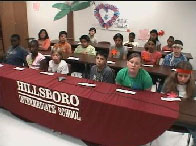
    2. During the connection, after each class has done their formal presentation, mute for 2 minutes to brainstorm questions. What could you ask the classes based on their presentations? What else do you want to know? You might even have some feedback/compliments to share with your partner class. For example, “We liked your PowerPoint presentation. Was it hard to find pictures for it? Where did you look?”
    3. Designate 3-5 students on a “question answer team.” These students are responsible for answering the questions from the partner class and make sure that one student answers at a time.
    4. Set up the question. Have the student(s) start with, Hi my name is _____. Then lead the question with a statement. For example, In our class, we have horses, dogs, cats and a lizard as pets. What pets do you have?
    5. When facilitating a multipoint session, don’t say, “Any questions?” Always call on schools by name (in the same order) so they know who should be talking.

    Comment Challenge/Comment

    • Try out one of these tips in your next videoconference. Tell us how it went.
    • Do you have any other question tips?
    • Do you have any stories of great questions students have asked?

    Comment and tell us about it!

    Day 13: Who Are You? and Where Are You?

    20 Days to Being a Better VC Coordinator

    Videoconferencing is a communication technology. “I know that,” I hear you say. But think about this. When was the last time you were in a videoconference and you didn’t know the name of the person you were talking to? I bet it was recently. It happens all too often!

    Introductions

    So for today’s challenge, let’s think about some tips to polish your introductions.

    1. Introduce yourself soon after you connect. Roxanne reminded us of this yesterday. Say, “Hello, this is ______ from ______ school in __________.” We want to know who you are and where you are!
    2. In large discussions with multiple sites, before stating your perspective, begin with “I’m _____ from _____ and my comment is…”
    3. Be sure to say the city and state. Sometimes it’s very helpful to include a frame of reference. For example, you probably don’t know where Berrien Springs is! So, I say, I’m Janine and I’m from Berrien RESA in southwest Michigan about an hour and a half around the lake from Chicago. Now, don’t you have a better picture of where I am?
    4. Prominently display a sign to identify your location.

    Student Introductions

    If you participate in many collaborations with other schools, here are two tips for making these introductions quick and easy.

    1. Create a little script that can be used for each videoconference. Write it on a note card and keep it by the videoconference cart/system. Tell us something unique about your area so we can get to know you. The next time you participate in a collaboration (Read Around the Planet?), hand the card to a student to read!
    2. Create a little PowerPoint with three to five slides starting with a map of your country, a map of your state/province, and pictures from around your town/city. Use a star or other large marker on the maps to show where you are. Every videoconference is an opportunity to reinforce geography!

    Comment Challenge

    Your challenge for today is to write your introduction script on a notecard or make a little PowerPoint or slideshow with pictures about your community. Have a couple students help you! Tell us what you included in it.

    Comment Comment

    What other tips or stories do you have on introductions?