Category Archives: Videoconferencing

Monster Mayhem and VC Tips with Whirlidurb

Cross-posted with the MACUL conference blog.

The last session in the TWICE room today at the MACUL 11 Conference was with Roxanne Glaser of Whirlidurb, sharing how to participate in Monster Mayhem along with excellent tips for quality videoconferences.

As usual, Roxanne modeled excellent presentation and teaching strategies! While we experienced a Monster Mayhem collaboration from start to finish, we also learned five important tips:

  1. Make a sign to show your location.
  2. Use a document camera.
  3. Fake it! if you don’t have a document camera.
  4. Arrange your students’ seating.
  5. Create a space for the students to speak.

We saw examples, then we reviewed from the handout, and then we divided into teams to do all 5 during the VC! I’m sure everyone remembers now!

Roxanne explaining the 5th tip: setting up a place for the speakers to talk – zoomed in & location sign.

Another example of student speakers location.

Roxanne puts us to work!

Roxanne’s version of Monster Mayhem (the original VC version) is where each class makes a monster – usually 3D – and then works in groups to create the other class’ monster. During the videoconference, students look for similarities and differences and analyze the descriptions to see where the writing or following directions could have been improved.

If you want to learn more about similar videoconference opportunities, sign up for Whirlidurb’s mailing list!

Stories from the Classroom: Our First Year of Videoconferencing

Cross-posted with the MACUL conference blog.

It’s Thursday afternoon and Danielle Letter is hosting a session in the TWICE room called Stories from the Classroom: Our First Year of Videoconferencing. We are videoconferencing with a class in Bridgeport-Spaulding and they are sharing about all the videoconferences they’ve done this year.

Guess Who

First the students explained about a project they participated in – the class connected to a class in Canada. Each student had written descriptions of themselves and they had to figure out who was who from the descriptions. Danielle had posted this in CAPspace to get a partner. Here’s a snippet of the collaboration and you can read the whole thing here.

Students will begin preparation for their connection by drawing their face using principles of Art. After the drawing is done, students will write a short descriptive piece about their art detailing their characteristics.

On the day of the connection students will gather in groups and each teacher will show one drawing. After reading the description, students from the connecting site will guess which student created the drawing and writing. Finally classes will have time to get to know each other through questions and answers.

Native American Beads

Next the students shared about how they learned about Native American Beadwork talking to an expert at the Hartley Outdoor Learning Center. They learned all about Native Americans and created their own bead necklaces.

Monster Match

Next some students described about their Monster Match project. They connected to a class in Pennsylvania. Each student drew a colorful monster and described it. During the session two or three students from each class describe their monster while everyone tries to draw it. You can read the full description of the collaboration in CAPspace here.

Experiencing It!

After the students described their videoconferences, we got to experience them with the students.

For Guess Who, we saw a self-portrait that student had drawn, and then listened to the characteristics. Then we picked the student from a group of 5 students. After that the group of students introduced themselves. We did this several times. Here’s what it looked like. Students were lined up and we were guessing which student:

Then the students shared why they liked distance learning:

  • We get to see people on camera from other places.
  • We get to see different objects (from the Native Americans session).
  • We learn lots of new stuff.
  • 100% more fun than a paper!
  • We get to learn about other states and countries.

After this, we tried out the Monster Match. One of the students gave us directions and we followed as shown:

After this, the audience asked the students & teacher questions. Great interaction and the audience was enthralled and engaged during the whole session. One of the 1st grade teachers in the audience said this was the best session I’ve been to because I got to color! Great work, Danielle Letter, TWICE President!

Around the World in 80 Clicks BYOL Resources

Welcome to my MACUL BYOL participants! The session is called Around the World in 80 Clicks (with thanks to Silvia Tolisano).

Here is the link to many Skype resources.

Handouts were:

Collaborative VCs Wiki with lesson ideas

Assignment: Please use the comment feature below to document your plans for using Skype in your classroom.

  • What ideas do you have?
  • Where do you want to connect?
  • What do you want to learn from/with another class?

Designing Quality Projects MACUL Hands-On Session

Here are links to resources and projects mentioned in my Designing Quality Videoconference Projects hands-on session at MACUL 2011.

Featured Projects

Collaboration Examples

TWICE Resources

Other Collaboration Tools

Good luck with your future videoconference collaborations and projects!

TWICE ASK Programs @ MACUL

Arnie Comer, TWICE ASK Coordinator, is kicking off the first session in the TWICE room (W2-66) at MACUL 2011: TWICE ASK Programs.

What is an ASK program?

The basic steps to an ASK program are:

  • Read the book
  • Journal
  • Write good questions
  • Pick the best questions
  • Interview an author or specialist

Arnie’s session features Michigan author Janie Panagopoulos, who offers both ASK programs and writing programs:

Janie is interacting live with students at Eagle Lake Elementary, in Edwardsburg, MI, who participated in the TWICE ASK program Traders in Time in December, as well as the Polycom Special Event Writing Rules in January.

And that’s all I can write, because I’m off to teach a hands-on workshop! Sign up for a TWICE ASK session soon!

Snippets of Read Around the Planet

It’s been a great couple of weeks with Read Around the Planet 2011! We had 63 classes participate this year; and only a few of those are getting rescheduled. It’s been pretty busy, so I haven’t been able to blog too much of it; but I did capture some pictures and little snippets to share with you.

This Michigan class had clues about explorers; our Texas friends had to guess! They got them all right! I loved their props – the boat and ocean in the background. The explorers stood behind it when giving their facts. Note the student in the front. Does that help you guess?

Did you guess Jacques-Yves Cousteau?

This was a great example of how during Read Around the Planet, we really do encourage classes to share whatever they are studying! I even had a high school class connecting to an econ class for their RAP today!

Here’s an example of what not to do with the camera. I didn’t get a chance, but usually like to encourage classes to move their camera to better show the students. It’s ok to ask your partner class to move their camera too!

This class was sharing the story of Mrs. Wishy Washy – and everyone had dressed up – including the teacher! See the cows in the front row! Love the use of costumes!

I love connecting up and seeing a room full of Cat-in-the-Hat hats! Nothing like a great visual!

Finally a comment from a coordinator at one of our schools – this year every teacher is participating in RAP!

It was really good!  The whole class was involved and I really enjoyed it.  The partner teacher also complimented her and her class at the end by saying hers was the best-behaved and quietest class she had done a project with, and she does a lot of these.  This was her 5th or 6th of this year.  Anyway, so far so good on our RAP!

ASK Author with Eric Walters

The last three days we’ve been working with York Region District School Board in Ontario to share author Eric Walters between our schools. We’ve also shared it across Canada with other classes in Ontario and British Columbia as well. We split the author fee among all the schools participating. We’ve been collaborating like this for the last three years.

This program is a hybrid ASK program. Eric has a highly entertaining interactive presentation he does for schools – giving an overview of some of his books and the stories behind them. It also includes about 5-10 minutes background info on the book that is the focus on the session. The last 30 minutes of the session is that traditional Q&A session of an ASK program. We usually got 30-40 questions in each program, as Eric is very concise with his answers!

We had two days of sessions on the book Trapped in Ice, and then a new session today on the book Wounded.

In the Trapped in Ice sessions, students asked questions such as:

  • Why did you pick Helen to narrate the story?
  • Do you like your book or do you wish you could go back and touch it up?
  • Do you have advice for us when we’re writing our stories in class?
  • How did you choose and develop the characters in the book?
  • Have you ever disagreed with an editor?
  • Do you have any books with characters based on you?

Here are a sample of the questions from the Wounded session.

  • In each of your stories, at least one parent is missing. Why is that?
  • In the novel, Marcus’ feelings always seem so realistic. [Examples given]. How were you able to give such detailed feelings? Did you imagine how you’d feel? or did you do research?
  • In chapter 8 what made you think of not having the teacher react? Was that based on a personal experience? If you were the teacher, how would you react? People commonly don’t react to pain if they don’t know what to do. This book is being used to help teachers and spouses learn how to relate to those with post traumatic stress disorder.
  • In this book you didn’t describe how Marcus looked. I have a brother named Marcus, and I thought of my brother as I was reading. How did you think Marcus looked? I do that on purpose so that you’ll relate the character to someone you know.

Walters packs a lot of punchy advice and positive encouragement to students throughout the session. Teachers shared great comments afterwards:

We had a super video conference with Eric Walters.  He was very personable and gave great background information to the students.  I was very impressed along with the students.

Our students, and we teachers, enjoyed hearing about the writing process and the novel Trapped in Ice.  I think that Eric truly inspired a classroom of writers today.

TWICE ASK Author: Nothing But Trouble

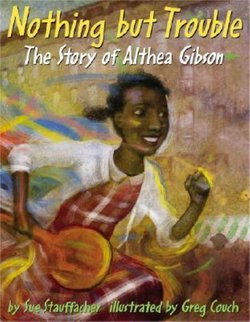
Today TWICE is hosting a day of sessions with author Sue Stauffacher on her book Nothing But Trouble: The Story of Althea Gibson.

Althea Gibson was “the first African-American woman to be a competitor on the world tennis tour and the first to win a Grand Slam title in 1956. She is sometimes referred to as “the Jackie Robinson of tennis” for breaking the color barrier.” – Wikipedia.

This program is an excellent Black History month program because the students get to learn much about the history of the time, as well as the writing process. Sue has a great PowerPoint with historical photographs that show the history and what Althea’s life was like.

Did you know that in Sue’s book Donuthead, the character Sarah Kervick is based on Althea Gibson’s toughness?! Now you’ll have to go read that book again to compare!

Here’s a flavor of the conversations and discussion from these sessions.

  • How do you get inspiration for your books? Usually by accident!
  • We noticed that the colors in the book around Althea Gibson are much brighter in the beginning of the book than at the end of the book. Why is that? The artist was trying to use colors represent how Althea moved from chaotic energy to focus towards the end of the story.
  • Why do you think Althea was so angry and wild? The answer included explaining how great athletes often have a wild streak and the ones that are great are able to harness and focus that energy.
  • What does “nicking sweet potatoes” mean?
  • What is your favorite part of the writing process?
  • How do you overcome writer’s block? I like to do something that uses my hands but not my head. Then I let the question rest in my mind and sometimes the answer comes!
  • What are your favorite genres?
  • In talking about publishing and failed projects, Sue explained to the students that if you want to succeed, you need to expect to fail. It takes persistence and many tries to succeed.
  • On her upcoming TillieRide, she invited the students to write notes to her to tell her how they overcame something. She said I’m scared, but sometimes you just have to overcome your fear!

Sue has a quirky sense of humor, and engages delightfully with the students. We hope you can participate in another session with Sue! There are still openings in the some TWICE ASK sessions with Sue in April if you want to join us!

Need Skype Partner Class – 8th Grade Social Studies

Help! Can anyone help me find another 8th grade social studies class? Here’s what my teacher wants to do:

Dates: February 22 – March 4 (M-F) (negotiable)
10:40 – 11:25 a.m. EST

A Southwestern, rural Michigan eighth grade class, studying the Great Depression, would like to connect through Skype, with a class from a different region in the United States (or elsewhere in the world). The students are interested in finding out how a different region of the United States (or the world) experienced the Great Depression. The Michigan students will PowerPoint to present discussion on the effects of the Great Depression in this part of Michigan.

Even if you could connect and listen to our class presentation it would be great. Please help!

Contact: Arlene Bailey at abailey@andrews.edu

TWICE ASK Author: Bessie Smith and the Night Riders

Today TWICE is hosting an awesome ASK program with Sue Stauffacher on her new book, Bessie Smith and the Night Riders.

Sue is a wonderfully funny author and students really enjoy her books.

Bessie Smith was the “Empress of Blues” and stood up to the KKK at a concert. This picture book tells that story, and during the session, students learn more about the historical setting and history of her story, while learning about the writing process as well. It’s an amazing program!

Here are some of the questions from today.

  • Bessie Smith is a blues singer. Are you a fan of the blues and who are your favorite blues singers?
  • In the book, Bessie is dressed up with fancy clothes. Did she really dress like that? Sue had great pictures to show when answering this question.
  • If you were a character in the book, would you be like the girl who stood behind Bessie or would you be like the boys who ran away?
  • Are the songs in the story real, and how did you choose them?
  • Are there other events in Bessie’s life that you considered writing a story about?
  • What was Bessie Smith’s favorite place to perform?
  • Do you think the KKK still exists today?
  • What gave you the courage to write your books?

Sue Stauffacher loves the ASK program because of the depth of questions and discussion with the students. She also helped students understand the revision process and how challenging it is, and how she moves through the process. It’s partly in your attitude – being willing to make something you like even better!

By the way, there are still openings in the some TWICE ASK sessions with Sue in April if you want to join us!