Tag Archives: International VCs

TX – Canada Read Around the Planet Story

Still interviewing people at NECC 2008. In this video, Angela Conrad from Humble ISD, TX tells about a Read Around the Planet connection with Alberta, Canada.

If the YouTube video below is blocked for you, try this link to the same video on TeacherTube.

The International Teddy Bear Writing Project

Sunday night during the global poster gallery at NECC, I thought I’d interview the presenters and post the interview online. Yes, I asked them for permission!

The presenters were Cathy Timpone, Park Ridge Public Schools with Agnes Zaorski.

The Teddy Bear project is described online, and this Moodle site is used to support the project.

If the YouTube video below doesn’t load, try it from TeacherTube.

Is it just my computer or my hotel Internet connection or did YouTube pull a lot of frames out of this video? This is my first try with this idea and I may need to tweak the process a bit.

Five Interdisciplinary Goals for Global Education

In working on my literature review, I ran across a reference to this paper. Thankfully, it’s been shared online so you can read the whole article if you wish.

Hanvey, R. (1977). An attainable global perspective. New York: The American Forum for Global Education.

The paper suggests there are five interdisciplinary goals for global education: (a) perspective consciousness, (b) state of planet awareness, (c) cross-cultural awareness, (d) systematic awareness, and (e) options for participation (Hanvey, 1977).

I thought it would be interesting to see how we’re using videoconferencing to meet some of these goals.

Perspective Consciousness
Which basically means, are you conscious of the fact that other people have other perspectives?

  • Global Nomads programs certainly address these issues, especially the Pulse programs which explore differing opinions on hot topics.
  • The misconceptions program we did in April began to raise this awareness for the middle school students involved.

State of the Planet Awareness
This includes an awareness of current events, conflicts, etc. around the world.

  • Many schools have current or world events classes and the Internet makes this study a lot easier.
  • Global Nomads programs again are amazing to help students be “onsite” in the country learning from students their age what life is really like for them. The recent programs from Kenya on the elections are a great example of this.
  • Eco-Conversations, brought increased environmental understanding from a global perspective to Dowagiac students this page school year. We intend to run it again next year, and you are welcome to replicate the project too if you wish.
  • What about how our students reacted to the earthquake in Pakistan a few years ago?

Cross Cultural Awareness
Can surface contact via videoconference raise awareness? Can it bring deeper understanding? Certainly it’s not like living in the culture for a year or more. However at least it’s the beginning of teaching students that others have different values and perspectives. Some potential examples include:

In addition, I think the research by Lee and Cifuentes get at the challenges of moving to the higher levels of cross-cultural understanding described in Hanvey’s paper.

Systematic Awareness
This one is harder. I couldn’t think of an example of a videoconference that starts to address this goal. Can you? This is the definition from the paper:

some modest comprehension of key trails and mechanisms of the world system, with emphasis on theories and concepts that may increase intelligent consciousness of global change

Options for Participation
This one is more difficult too, but I think the recent Videoconference for Hope hosted by schools in Edmonton, Alberta is one possibility.

What do you think? Have you done an international videoconference? Did it meet any of these goals for global education? How will this article change or inform your next international videoconference?

Learning about Australia from Students in Sydney

Classroom Exchange
Our Upton Middle School students just finished connecting to the Reef HQ. Now, they are talking to middle school students at Scots College in Sydney.

We had 3 girls from our school, because everyone else is at soccer practice or other activities. The school we connected to was an all boys school, so it was a fun exchange.

Our students started by telling a little about our town, St. Joseph and the schools in the district. Then they shared a presentation about their area, including their beaches. We learned all about rugby and cricket, and some of the best Aussie sites to see. Another presentation from the Australian students covered the flora and fauna in their area.

Here are some questions we asked each the Australian students. Our students had used CultureGrams to compare the countries and prepare questions.

  • What brands do you usually wear?
  • Australians live longer than Americans, so why do you think that is? Our students think it’s because of smoking in the U.S. Do people smoke a lot in Australia?
  • How many of you have cell phones?
  • What are some of the popular books around your school?
  • When you think of Americans, what do you think of? (loud, “out there”)
  • What do you think is most important for us to learn about Australia?
  • What TV shows do you watch and what bands do you listen to?
  • What do you have for pets?

Some of the funny word differences that we really laughed about were:

  • thongs in Australia, flip flops in the U.S. (lots of red faces on both sides with this one)
  • “heaps” in Australia, “lots” in the U.S.

Some of the questions they asked us were:

  • What are popular sports in Michigan?
  • What do you do in an average day?
  • Is basketball big in your area?
  • Do you travel around the U.S. a lot?
  • Do you have South Park on TV?
  • When you think of Australians, what do you think of? (surfers, kangaroos)
  • Have you ever heard of Steve Irwin?
  • Do you play rugby?

A funny line from Australia was “we’re the only country that eats our emblem.”

These two experiences were part of a unit on Australia and turned out to be a great experience. We learned some lessons about scheduling and hopefully will have more students on our end next time.

Diving the Reef HQ in Australia

This evening Upton Middle School students are connecting to the ReefHQ in Townsville, Queensland, Australia.

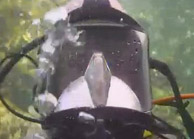
We started by the students taking a deep breath to go diving. The diver explained how his mic & breathing system works. Then he gave the students a tour of the reef, showing and explaining the coral reef. He showed different corals and asked the students to guess the name of the coral (brain coral, honeycomb coral, etc.)

The excitement in the room was palpable. All of us were exclaiming to each other how cool this is! A custodian walking by came in to watch for a while.

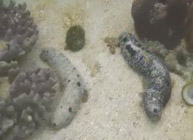
We laughed at a sea cucumber that breathes through it’s bottom. We learned about creatures living on the sand, and more in the lagoon. During the tour, we asked a few questions too. We were able to watch a starfish retract it’s stomach too.

Next the diver switched over to the shark tank. During the switch, Julie, the reef guide, asked the students questions to review what they had learned so far. We found out that the coral reef exhibit is 37 m long and 4.5 m deep and holds 2.5 million liters. The shark holds about 750,000 liters. We chatted about the movie Finding Nemo and how it corresponds to real life.

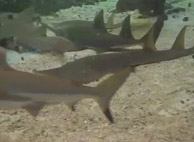
It was great to watch the diver swim with the sharks and get close up views of the different types of sharks in their predator tank. We met so many different sharks and fish, including one that likes to nibble the camera.

The students thought the video was incredibly good (we connected at 384 K at H.264). A green sea turtle enjoyed a scratching on its back and came to say hello.

This was a great experience, and I’m sure we’ll be doing it for an after school evening activity again!

Around the World: Misconceptions Resolved

This afternoon Coloma Middle School, one of our RUS grant schools, is participating in a 3 hour Around the World session with countries in Central and South America. The sessions focus on “misconceptions resolved” as misconceptions are part of the 7th grade language arts curriculum for Coloma.

Costa Rica
Lincoln School, Costa Rica started with a presentation with an overview of their country and their school and daily life. Next they presented their game show to quiz our students on their culture. Many of the questions were taken from their presentation. Some of the questions were:

  • What is the capital of Costa Rica?
  • What is the most popular sport in Costa Rica?
  • What countries neighbor Costa Rica?

Next, our class presented about Coloma, Michigan, and misconceptions about America. They created humorous skits about the misconceptions. We started the game show, and then ran out of time. Clearly, though the students were having a great time!

Nicaragua
Soon the American Nicaraguan School connected and we checked audio and video. Their students weren’t quite ready, so we played the “small town America” game for a few more minutes.

Then Nicaragua shared their humorous skits about misconceptions about Nicaragua. They were video clips liked the ones from Coloma. Both sets of video clips were a little hard to understand due to soft voices and background noise. We certainly learned a few lessons with those skits!

Then we played a Jeopardy game about Nicaragua Physical Geography, History and Culture, and Human Geography. We rotated between American and Costa Rica to compete in the game. Questions included the largest lake, types of food, etc. We just finished the Nicaragua game show in time.

We took a 20 min break for our Michigan students to eat since it was 5:00 p.m. here.

Guatemala
Soon Guatemala connected in. We started with quick intros from the participating classes, and then they started their presentation. They showed many pictures. Then we played their jeopardy game with American and Nicaragua competing. Guatemala had trouble with their skit video clips, so we played the jeopardy game about rural America with Nicaragua and Guatemala competing. This was a really fun format and the students in each class were really involved.

Finally at the end, we were able to watch the skits from Guatemala with misconceptions about their country.

Lessons Learned
We learned again that it’s important to slow down and speak clearly! It’s so easy to get excited and talk so fast! Laughing while talking makes it even harder to understand. We also had trouble with all of the video clips for the skits. They were very difficult to hear. We’ll have to think more about what could make these work better! I think that video clips probably can’t work unless there is a mic on the presentation. In a live skit, you can have the students come closer to the mic and speak slower. However in a taped skit, it’s hard to make it easier to hear.

Due to a comedy of scheduling problems, we didn’t connect to a country every hour for 12 hours as we originally planned. However we had a great connection with these three schools. We appreciate the hard work from all the students who participated in this set of videoconferences!

Reading Around the Planet with Wales

One of my schools had conflicts with the scheduled Read Around the Planet dates this year, so I helped them find partners later in March. Our first connections were this week, and more are scheduled next week.

Today’s session is one of three that we scheduled with Wales. We’ve been working on several collaborations with Wales.

Our class is first grade, and their students are close to the equivalent to 3rd and 4th grade students.

08-03-14wales.jpgOur class started with a song about sounds and words that have those sounds. Then the students shared a story called Lazy Mary. The class read the story together and two students acted it out.

The class in Wales had different groups talk about various components of Welsh culture.

Their students asked our students, “Where is Wales?” our kids said, England! One of the things that I’ve learned as we do more connections with the United Kingdom is that there is a perception in the U.S. that the UK is the same as England. Whereas people from Wales and Scotland really don’t appreciate that! I’m not sure that this misconception actually got cleared up in the session today. I don’t know what it would take to clear this up, but I think probably when we connect to schools in Wales and Scotland we need a map and an explanation of where England is compared to where they are. When I first started to understand this confusion, I had to look it up online to get a grasp of the situation. It’s certainly confusing on this side of the Atlantic!

Here are some examples of the questions the students asked each other.

  • 08-03-14wales2.jpgAre you actually by Lake Michigan?
  • What is the weather there?
  • What time is it there?
  • Do you have uniforms?
  • What subjects do you learn?
  • How many students are in your school?
  • What’s the coolest thing about your culture?
  • What TV shows and movies do you like? Simpsons and SpongeBob on both sides of the Atlantic!
  • What kinds of foods do you eat?

It was a great connection and hopefully we’ll continue our collaboration with Wales.

What is the Western Hemisphere?

Have you ever noticed how videoconferencing expands your thinking? How you learn new things every day, even if you’re just hooking up classes to the next place and making sure the connection works?

This week I realized even this even more. I noticed how VCing makes you more aware of how other people define things differently than you might…

We’ve been running MysteryQuest World Geography since 2002. One of the areas of the world we focus on is the Western Hemisphere. I’ve always thought of it as my local teachers do also – that it’s basically North, Central, and South America. Which is also how our textbooks and curriculum seem to define it.

But when the second Canadian teacher submitted the country for Western Hemisphere that wasn’t in one of those areas, I decided I’d better learn some more. So I asked Google and found this from Wikipedia (emphasis mine):

The Western Hemisphere, also Western hemisphere[1] or western hemisphere,[2] is a geographical term for the half of the Earth that lies westPrime Meridian (which crosses Greenwich in London, England, United Kingdom) and east of the International Date Line.[3] It is also used, mainly by Americans, to specifically refer to the Americas (or the New World) and adjacent waters, while excluding other territories that lie geographically in the hemisphere (parts of Africa, Europe, Antarctica, and Asia). Thus this is sometimes referred to as the of the American hemisphere, despite the fact that it is by no means a hemisphere.[4]

Sizzle. Pop. Can’t you just hear my understanding expanding? 🙂 Ah, the beauty of videoconferencing!

Daylight Savings Time and the UK

Daylight savings time changes on Sunday in the U.S.! Did you remember?

It doesn’t affect our connections with Canada, because they switch at the same time we do. But it does affect connections with the UK (and Arizona). I have three with the UK that I have to adjust because I forgot (AGAIN!).

Life was a lot easier “way back when” we switched to daylight savings time at the same time as the UK! What was Congress thinking??!!

Yet another little detail that I have to keep paying attention too!!! How are you handling time zone changes these days?

Lit Review: World's youth connect through Global Nomads Group: An interview with GNG's David Macquart

Lit Review: This is a post in a series focusing on the research studies on videoconferencing.

Morrison, J., & Macquart, D. (2006). World’s youth connect through Global Nomads Group: An interview with GNG’s David Macquart. Innovate, 2(4).

Author: Morrison, J and Macquart, D
Title of article: World’s youth connect through Global Nomads Group: An interview with GNG’s David Macquart
Publication year: 2006
Database source: Innovate
Name of journal: Innovate
My Codes: VCContentProviders

Main Point: This article is an interview between Innovate’s editor and one of Global Nomads Group (GNG)’s founders. The article shares the history of GNG, it’s impact, features some of the programs, and shares the challenges.

Theoretical Framework/References: Not applicable, not a research study. The one reference is used to show that Americans lack in cultural understanding.

Methods, Sample, Variables/Case:  Not applicable, not a research study.

Findings: Not applicable, not a research study.

Author/Audience: The audience is the Innovate readership.

Questions/Thoughts/Implications:
The article shows how the vision of a few to meet the needs of students can expand to a respected non-profit organization.

GNG has offered some incredible international programs, but they are often only offered that one year. This makes it hard to “institutionalize” the learning. GNG wishes to offer more programs more consistently, but is hampered by funding issues. Nevertheless, many of our students have benefited from the incredible learning experiences offered by GNG.

“Most of the issues addressed in our programs continue to challenge governments and international institutions….” GNG certainly doesn’t skirt around tough issues. They have the facilitation expertise to deal with tough issues too. I’ve experienced their facilitation skills both in training and with students

This article provides anecdotal evidence of the power of videoconferencing to bring experiences and interactions to students that would be impossible otherwise.