Tag Archives: Collaborations

Solving Math Problems with 6th Graders

This post is cross-posted at the MACUL conference blog.

Another jam packed TWICE room (W2-66), this time with Danielle Letter, from Atkins Elementary in Saginaw, MI. We videoconferenced with 6th graders back in Atkins Elementary.

Here’s Danielle’s handout.

Danielle is giving us an experience with the type of videoconference called Math Maniacs. The kids read some math problems to us. We divided into groups and solved the problems while the students worked on solving some other math problems. Then we read some problems to the students… Some of the problem titles were:

  • Toothpick Problem
  • The Million Mystery

Danielle: Are you ready?

Kids: No, we’re not! This is HARD! They’re teachers!!

Both sides muted the microphone and worked on their math problems.

Danielle: All you need to do this is two classes, and some math problems. You can do it over videoconferencing, or Skype, or with an overhead projector with the class next door in your class. A document camera (Elmo, AverMedia, etc.) is helpful to share the math problem with the other site.

95% of what we learn is when we’re teaching someone else. So the students are teaching other students how they are solving their math problems.

Why do we use problem solving?

  • Because of the collaboration
  • Can be open ended
  • Can be not one right answer
  • Appeals to many learning styles
  • Encourages multiple strategies to solve the problem
  • Promotes stamina

Then we tried to solve our problems. Lots of quality work time, brainstorming and problem solving at both sites. See how one of the groups solved the toothpick problem.

After that, the 6th graders explained to us how they solved their problems, and we explained how we solved our problems. We learned about strategies guess and check, drawing a chart, acting it out…

Some student quotes on why they like problem solving:

  • It’s really good because you don’t just come up with the answer with a calculator. You use your mind by yourself and you feel really good. I like it because of the accomplishment.
  • I like it because it’s challenging. You have to do it over and over again until you get it. But you keep trying and get it and you realize that it’s worth finding the solution to it.

Nothing like hearing in the words of a kid!

At the end, our teachers didn’t want to share their answers, and the 6th graders said that we were camera shy. Everyone laughed!

Thanks Danielle, for showing us the cool ways to engage kids in teaching others and solving problems.

Links from my CAPspace / RAP Presentation

Follow-up from my Collaborations Around the Planet and Read Around the Planet session at the 2009 MACUL Conference in the TWICE room.

CAPspace MACUL 2009 PowerPoint

Collaborations Around the Planet

Read Around the Planet

Information for Collaborations

Projects Featured

My Upcoming Classes

More Info

  • Explore the tabs above to see my projects and my literature review in process.
  • Note that you can subscribe to my blog above using the RSS feeds or the email option (if you so choose).

Visiting Wales, then MSU Museum

This post is cross-posted at the MACUL conference blog.

It’s the first session after Alan November, and the TWICE room (W2-66) is jam packed with participants anxious to learn virtual field trips. Greg Marten, Lenawee ISD is presenting How Do I Find A Virtual Field Trip? Look TWICE!

After an introduction to videoconferencing, we connected to Lynsey Russell‘s class at Woodlands Elementary in Cwmbran, Wales to hear their Read Around the Planet presentation that they did with Ohio a couple weeks ago. The class started with a little introduction of geography of the UK. Then they sang us a song. The kids were so cute in their red, white and black uniforms. Huge round of applause from the teachers in the audience. We heard a Welsh song, and then a poem about a dragon in English. The poem was about the dragon who ate the school. Complete with actions and wonderful expression! Wonderful performance poetry.

One of the participants on the front row sang all the songs with the students and did the actions. She had Welsh background so that was a nice connection!

We had a chance to ask them questions:

  • What is the weather like?
  • What kinds of things do you do on the playground? (football, cricket, and basketball)
  • Do they learn Welsh in school?

After going to Wales, we got online for a while. People with laptops went to the TWICE website. The Projects section is where you can learn about connections like we did with Wales. The rest of the session focused on videoconference programs or field trips and how to search the Berrien RESA Videoconference Program Database. Participants learned about the TWICE discounts and other features.

Next, we headed over to the Michigan State University Museum to hear about their programs.

They gave us a tour of their studio – a little closet when you look offline. They have a green screen, which is of course very neat and makes it easy to see the visuals and the presenter at the same time. We got a nice overview of their programs: evolution, adaptations, and termites. We also heard crickets, saw pictures and video clips of various creatures. MSU Museum is one of the more affordable providers, with a cost of $50 per session.

If you haven’t seen a videoconference yet, plan to stop by the TWICE room (W2-66) for one of the upcoming sessions!

Lit Review: Video Conferencing in the Classroom

Lit Review: This is a post in a series focusing on the research studies on videoconferencing.

Arnold, T., Cayley, S., & Griffith, M. (2004). Videoconferencing in the classroom: Communications technology across the curriculum. In T. Arnold (Eds.). Available from http://www.global-leap.com/casestudies/book2/index.htm

Summary: This book of 97 pages is still one of the best resources for an overview to videoconferencing and how to use it in the classroom/curriculum. Authors include Mike Griffith, of Global Leap fame. It was originally published in 2002 and was updated in 2004.

The first chapter reviews the components of videoconferencing and provides suggestions and guidelines on purchasing equipment. This of course is a little dated, with ISDN still listed first, and concerns expressed about the quality of videoconferencing over the regular Internet. These problems aren’t as much of an issue as they were in 2004 and earlier.

The Getting Started section has suggestions for setting up, getting training, and some introductory videoconferences just like Cheryl is offering for her schools. There are step by step guidelines for making your first exploratory sessions a success.

The next section has extensive detail on how to plan for “the use of videoconferencing across the curriculum.” For each major curriculum area, there are a plethora of ideas for collaborations as well as connecting to experts. Non-UK readers will need to translate the references to the Key Stages.

The next section gives a detailed overview of the Global Leap website and the resources and tools found there for subscribing schools.

Section E has detailed information on preparing for the videoconference, including a nice list of best practice tips. Section F goes into further detail on videoconferencing technology and all the options and choices, followed by a detailed glossary.

The authors reflect on the future of videoconferencing in Section H, with specific requirements that would be useful for vendors hoping to improve their products for educational videoconferencing.

Comments: If you’re new to videoconferencing, this book is a must read! Download it now and review it carefully. Even experienced VCers will find tips and tricks to make videoconferencing in the curriculum more effective.

Read Around the Planet to SK, no, wait, TX!

subtitle: Twitter saves the day.

This afternoon we had a Read Around the Planet connection to Saskatchewan that fell through at the last minute. So I posted it at 12:15 to Twitter that I desperately needed an audience class, and by 12:30 I had a partner, thanks to Roxanne and Beth Alton.

Our class had been working on Japanese storytelling, called Kamishibai. The students wrote a story, then illustrated it with beautiful drawings on cards.  Here’s a sampling of the drawings. They were very nicely done.

Japanese storytelling

Several students also shared nice little write ups about Michigan, Stevensville, and their school. We were so grateful to have the students in Texas to be an audience for us.

Of course, then we had the question and answer part. Here is a sampling of some of their questions.

  • How cold is it?
  • Do you have Dr. Pepper?
  • What kind of food do you like? The Moody high school kids told us that they eat snakes and armadillos. But then after our kids reacted, they said they were kidding. Everyone laughed!
  • Do you have any beaches? (we do – Lake Michigan)
  • Do you have movie theatres? (both small towns)
  • What kind of music do you listen to? (from MI); What’s y’alls favorite band? (from TX)
  • Can we find your town on a map? (TX answer: maybe, it’s really small!)

Our kids loved to say “goodbye y’all” at the end. They said, “are y’all making fun of us?” No, we just think it’s cool! Thanks to Roxanne and Beth for saving the day!

Shadow Puppets for Read Around the Planet

Still continuing our Read Around the Planet connections this week. Today two classes from River Valley Middle School are connecting to South Carolina and Virginia. The 8th grade students have been studying the book Anne Frank. Recently they did the Anne Frank program with the Center for Puppetry Arts.

Shadow PuppetsBased on that inspiration, they shared two shadow puppet plays that the students wrote. The play came across really well in the videoconference. In addition, a couple of groups also shared their rap written about Anne Frank. Our partner class really enjoyed the puppet shows.

Still another 23 Read Around the Planet connections to go!

ESL Read Around the Planet

After the first week of so many Read Around the Planet connections along with other VCs, I finally was able to actually watch a full session today. We have 63 RAP sessions this year.

Read Around the PlanetToday’s session was an ESL Read Around the Planet. We started by our 7 students saying their name and hello in their native language (Spanish and Korean). Then our friends in TX also said their names.

Our friends in Texas shared a song with us. Then our students taught the kids in Texas the alphabet using ZooPhonics with actions. Our class sang about the animals that live at the zoo.

Read Around the PlanetOur friends in Texas shared the beginning of a book about an animal in the zoo. Then they shared a song about colors, with each student representing different colors.
Some of the questions the students asked each other were:

  • What is your favorite food?
  • What is your favorite book?
  • What is your favorite toy?
  • What kind of weather is it there?
  • Why aren’t you wearing blue? (one class had uniforms and the other class didn’t)

The students enjoyed a great conversation and learned about each other. Reminds me why I love this project!

Mexican Dances

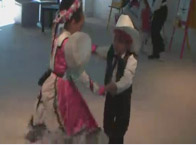
Mexican DancesToday we have a couple more sessions with Frank Garcia at the Pedro Zaragoza Foundation. Today’s classes were middle school exploratory language classes. They were treated to several dances, interspersed with some question and answer time. Our students asked:

  • How old were you when you started to learn the dances? (5 years old)
  • How long does it take to learn the dances? (about 3 months)
  • What time is it there?
  • Is it hard to learn the dances?

The students in Mexico asked our students:

  • What are your names?
  • Do you want to learn how to dance?
  • What kind of music do you like?
  • If it’s cold, why aren’t you wearing sweaters?

I would like to think of some more ways the students could interact and do some games. Maybe they could teach our students some simple steps or some vocabulary. I would like our students to be able to share something too, that would be of benefit to the orphans.  What ideas do you have for interacting?

New VC Dissertation Published: Kindergarten VC

This morning I received an exciting alert in my inbox. Another dissertation has been published on videoconferencing. This one is by Debra Piecka – who organized the connection we did with Namibia a couple summers ago.

I’m sharing the abstract here, and will read and post more about it later. Here’s the direct link to the dissertation in ProQuest if you have access to that dissertation database.

Show and tell: Learning with interactive videoconferencing in kindergarten
by Piecka, Debra C. Burkey, Ed.D., Duquesne University, 2008, 426 pages; AAT 3338618
Abstract (Summary)

The research investigated how kindergartners make meaning using interactive videoconferencing. The study explored two research questions: (1) What types of meanings are being formed by the kindergartners during interactive videoconferences and,( 2) What are the nature of young children’s emerging inquiries and dialogue surrounding their use of interactive videoconferencing in their classroom? The study embodied a Vygotskian perspective as the theoretical framework in order to meet demands associated with the young participants’ vulnerability, developmental appropriateness, and the students’ interactive learning environment. Employing an ethnographic, participant observation methodology, the research design was informed by three criteria: (1) a pilot study, (2) Miles and Huberman’s (1994a) recurring themes in qualitative data analysis, and (3) literature review results emphasizing the nuances of contemporary culture. Field observation occurred from October 2007 through February 2008 in a Southwestern Pennsylvania kindergarten classroom. Students participated in 7 videoconferences with distant peers or content experts. Data from a gingerbread and puppetry videoconference and an astronomy program were selected for further analysis based on their ability to illustrate poignant examples of how the kindergartners formed meaning during collaborations. Data analysis procedures involved the importing of dialogue from videoconferencing transcriptions, field notes, and other artifacts into the ATLAS.ti qualitative data analysis software for open coding, data display, and grounded theory development.

Results developed from open coding and concept maps in ATLAS.ti informed the following theory development. First, learning with interactive videoconferencing in kindergarten supports meaning making from four Vygotskian tenets: (1) the social origins of learning, (2) sign and tool use through mediated activity, (3) the importance of language, and (4) support for the zone of proximal development. Additionally, the students’ meaning making involved the tenets’ entwinement rather than the solitary occurrence of individual tenets. Regarding the kindergartners’ emerging inquiries, during sustained interactive videoconferencing levels, children’s inquiries and dialogue evidenced exploratory talk that was purposeful, reflective and self-directed. It also indicated comfort with the technology. This study is unique in its multidisciplinary application of Vygotskian learning theory to kindergartners’ meaning making with videoconferencing and provides a foundation for extended use of qualitative methods to examine young children’s’ learning with technology.

I think it’s so interesting that this study is on kindergarten students.  Last week I tested with Richard Sands for Read Around the Planet, and he said his kindergarten teachers use VC the most. One of my “top teachers” that I studied last spring was a kindergarten teacher who did 12 VCs in the 2007-2008 school year.  One of the studies that I’ve been using in my collaborations presentation is on a kindergarten sustained collaboration. And, finally, one of Sue Porter’s favorite Read Around the Planet stories is of a kindergartener. So, how about you? How are your kindergarten classes using VC?

Nebraska Keynote Links

Greetings to my Nebraska ESUPDO audience. Here are a collection of links and resources mentioned in my presentations.

Breakout Session

Collaborations Around the Planet

Read Around the Planet

Information for Collaborations

Content Providers

Keynote Presentation

More Information