
Tag Archives: Collaborations

KC3: Kids Creating Content

USDLA: KC3 by Jan Zanetis

Showing the Stamford High School programs…

History of KC3 – Jan’s conversation with Alan November inspired it the start of the program.

15 schools signed up to create content; 100 schools indicated interested in being the test audiences for the contest.

The classes signed up and the KC3 team worked with them to prepare their presentations for the contest.

Then they did the program with a test audience and it was recorded on a TANDBERG Content Server in TN. The judges then accessed the programs afterwards and completed an online rubric to judge the program.

The project has snowballed where the classes are presenting their programs to other classes, and even generating additional projects and videoconferences with each other.

There were some great little clips of the students. It’s always fun to see kids present. We all laughed and enjoyed the students’ creativity!

Another clip showed the Q&A after the field trip was over. The classes brainstormed other VCs they could do with each other and what else they could teach each other about their communities. These are the same kind of amazing conversations that happen after Read Around the Planet and similar events.

In preparing their presentations, the students addressed a lot of NETS standards.

Jan has a pyramid of VC with distance classes at the bottom, then accessing content providers, then collaborative student projects, and at the top content creation in the classroom.

Comment from a student – “I didn’t realize that teaching was so hard.” That’s a great quote!!

The teachers said that it was hard work, but that the level of student engagement was incredible. Students had to dig deeper to really understand the in depth content to share it with the other class.

The teachers also said it was really eye-opening to see their students present the content – they saw their students engaging with the content at a different level than they usually see.

Don't Make Me Collaborate

USDLA Session: Don’t Make Me Collaborate by Kat Bailey and Samantha Penney

Some snippets from this session…

A lot of 30 second ideas of things you can do with your cell phone. What can you learn or do in 30 seconds…. well some of them you could post in 30 seconds, but if you were going to think reflectively about them, you couldn’t do it in 30 seconds.

Wikinomics by Tapscott covers these areas:

  • sharing
  • acting globally
  • openness
  • peering

Collaborative culture

  • ceding some control
  • sharing responsibility
  • embracing transparency
  • managing conflict
  • projects take on a life of their own

These are described in this session in the context of teaching online – letting your students experience a collaborative culture. Suggestions for managing group learning online like having student contracts for their work in it.

Vision of Students Today – digital ethnography. When I searched that, there’s a K-12 version of it. Did you know? I’m surprised how many of the participants here haven’t seen this video. Does that mean I’m going to too many conferences?? or reading too many blogs?

Suggestions include – create an infrastructure for collaboration in your class. I think this is what Jazz does – creates an infrastructure for collaboration. I can think of some other groups I’m in where we use collaborative tools to create the infrastructure for collaboration.

The conversations about cell phones at this conference is really intriguing. There was a Marc Prensky quote about learning anything on a cell phone.

There were some hints at constructivist learning – “leave out the piece you want the students to learn” and let them find it.

It seems like the new “must have” for conference presenters is a clip from YouTube. Hmm. There was a cool one with flowers and poetry that was a sample of student work.

Reference to Classroom20Wiki – with a recommendation of using these ideas in the classroom. It’s really about integrating technology in the curriculum, but with a Web 2.0 twist, a distance learning twist, and focusing on higher ed classrooms. Interesting perspective

Engaging your “waiting collaborators”: use the collaborative tools to create surmountable challenges and let them have fun with it.

I think we’re doing well with using the Web 2.0 tools to support our collaborative projects, as well as training such as Jazz. How are you using collaborative tools to support your work?

One Videoconference System per Child

Did you see this in the Wainhouse Research Bulletin a few weeks ago? Be sure to click the link to see the picture!

MIT Launches One Videoconferencing System per Child (OVPC) Nicholas Nery of The Manchurian Institute of Technology thinks everyone in the world should have a videoconferencing system.
The world famous professor, author, researcher, and diplomat has launched the non-profit OVPC organization to design, manufacture, and distribute the world’s most affordable videoconferencing system, priced at less than $100 and aimed at youngsters in the developing world. With moisture-resistant seals and a crash-proof hard drive, combined with built-in WiFi, colorful cables and connectors, solar panels for mobility and power generation in remote areas, and a high definition camera, this hardly-no-frills system supports 720p video and Siren-14 stereo audio. Prototypes of the SIP-based, H.264-compliant device are due to ship in Q4-08.
The company is concentrating on serving populations in underdeveloped and/or war-torn regions of Western Africa, South East Asia, and Texas.

Texas at the end of the paragraph surprised me. If any of you are involved, please comment and tell us more about it!

There’s also an interesting commentary on this development on the OLPC News site. I hope that those involved can imagine more instructional educationally engaging experiences besides just this:

Imagine entire country’s classrooms, full of children, in a massive multiplayer online conference.

Good that someone’s thinking about the bandwidth implications too:

I just hope that SES Global can handle all that data traffic on its donated bandwidth or there will be a lot of disappointed children (and adults).

So far, we’re still working on access to videoconferencing in each school. One of my superintendents wanted to know how to get VC in all the classrooms, even though it’s highly unlikely (at their present use rate) that they’ll ever do more than one VC at a time. Do you see a time in the future when every classroom at least has VC? Do you think the vendors will ever make desktop VC low cost that has audio designed for a classroom and maybe camera presets too? is that too much to ask for a low cost desktop system? What do you think?

Reading Around the Planet with Wales

One of my schools had conflicts with the scheduled Read Around the Planet dates this year, so I helped them find partners later in March. Our first connections were this week, and more are scheduled next week.

Today’s session is one of three that we scheduled with Wales. We’ve been working on several collaborations with Wales.

Our class is first grade, and their students are close to the equivalent to 3rd and 4th grade students.

08-03-14wales.jpgOur class started with a song about sounds and words that have those sounds. Then the students shared a story called Lazy Mary. The class read the story together and two students acted it out.

The class in Wales had different groups talk about various components of Welsh culture.

Their students asked our students, “Where is Wales?” our kids said, England! One of the things that I’ve learned as we do more connections with the United Kingdom is that there is a perception in the U.S. that the UK is the same as England. Whereas people from Wales and Scotland really don’t appreciate that! I’m not sure that this misconception actually got cleared up in the session today. I don’t know what it would take to clear this up, but I think probably when we connect to schools in Wales and Scotland we need a map and an explanation of where England is compared to where they are. When I first started to understand this confusion, I had to look it up online to get a grasp of the situation. It’s certainly confusing on this side of the Atlantic!

Here are some examples of the questions the students asked each other.

  • 08-03-14wales2.jpgAre you actually by Lake Michigan?
  • What is the weather there?
  • What time is it there?
  • Do you have uniforms?
  • What subjects do you learn?
  • How many students are in your school?
  • What’s the coolest thing about your culture?
  • What TV shows and movies do you like? Simpsons and SpongeBob on both sides of the Atlantic!
  • What kinds of foods do you eat?

It was a great connection and hopefully we’ll continue our collaboration with Wales.

Gary Stager Makes Me Think…

After listening to Gary Stager at the MACUL 08 Conference, I went up to ask him about the handouts from his session yesterday that I missed.  In the course of the conversation, he said to me,

“Why do people identify themselves with just one technology?”

He was referring to some of the ideas in the Web 2.0 session he did yesterday that I had missed. He didn’t mean to, but he challenged my own practice.

It made me think! (Which I think is the point of listening to Gary Stager.)

I like to refer to myself as a “one technology girl”, referring to videoconferencing. I try to keep my blog focused on videoconferencing. Every time I go somewhere or see something or learn something, I’m trying to see how it ties to videoconferencing.

I want to say, how can we make our videoconferences more constructive? But I feel like I’m coming at it from the wrong angle, by starting with the technology. On the other hand, it seems that videoconferencing is a perfect fit for social constructivist learning because it’s a communication technology. I need to keep thinking about this….

One of Gary’s points was “less us, more them.”

Some beginning thoughts are:

  • what if the kids picked who they wanted to connect to instead of the teacher?
  • what if the kids researched to find and request an expert to connect with them via videoconferencing?
  • how often do we have the kids generate the activities and interaction?
  • with the KC3 programs, do the kids decide how to represent the topic? do they decide the topic?
  • what structures like MysteryQuest or Holiday Challenges could we create that are based on even more constructivist principles?

Gary also emphasized the importance of good prompts. We need more good prompts for teachers and students using videoconferencing. What tough questions could help them head down to a path of interaction with experts and/or peers?

These are just a few beginning random thoughts stirred up after listening to Gary today.  Off to the next session, but these ideas will keep simmering….

Reading with New York

Note: This post was written for the MACUL conference blog 2008 with attendees in mind. However I’m reposting it here because it seems it would be useful for readers here too.

Session: Collaborations Around the Planet: Social Networking for Educational Videoconferencing

In my session today, we started with two connections to New York State. Unfortunately, since I was presenting, I couldn’t grab any pictures. But those kids were so cute! The first class presented the animal riddles. Each first grader had a 3-4 sentence riddle about an animal. The teachers guessed the animals. The teachers loved it and it was a great model of how to get the audience involved in your presentation.

In the second connection, the students presented a skit based on the book Andrew’s Loose Tooth. Most of the students took turns narrating, and other students acted out the story. After both presentations, the teachers and students asked each other questions. “How many snow days have you had?” “What do you like about videoconferencing?” “Where are you?” etc.

These connections were illustrations of the project Read Around the Planet. We were also able to compare a 384K videoconference (standard definition) with an HD (high definition) 2M connection from Polycom HDX to HDX. We saw an obvious difference in the clarity. We still got some packet loss and pixelation, but we’re pretty sure the conference didn’t give us QoS on our connection so it was probably on this end.

Afterwards, we talked about how to get videoconferencing going, participating in Michigan Week Connections, how to use the Collaborations Around the Planet website, and shared stories of other videoconferences we’ve done.

Daylight Savings Time and the UK

Daylight savings time changes on Sunday in the U.S.! Did you remember?

It doesn’t affect our connections with Canada, because they switch at the same time we do. But it does affect connections with the UK (and Arizona). I have three with the UK that I have to adjust because I forgot (AGAIN!).

Life was a lot easier “way back when” we switched to daylight savings time at the same time as the UK! What was Congress thinking??!!

Yet another little detail that I have to keep paying attention too!!! How are you handling time zone changes these days?

Inventors from the Past

08-03-03inventors.jpgThis afternoon, students from Calvin Britain Elementary, Benton Harbor, are doing their first videoconference and presenting a series of skits and songs for other students in our county. The focus is on Black inventors from the past, particularly those from the 20th century.
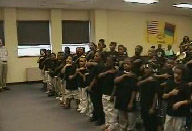
After a welcome from the principal, the students sang Lift Every Voice.

Next, the students performed a skit showing what life would be like if there were no Black people in the world. Each part of the day featured missing everyday items like the iron, the clothes dryer, the lawn mower, the auto gear-shift, the pencil sharpener, and the traffic light that were invented by African-Americans.

08-03-03inventors2.jpgThe students then all sang the song, We Shall Overcome, including actions to the song.

After this, the students gave some clues about some famous African-Americans in the form of “I am” statements. The listening students tried to guess the person.

This program was originally scheduled for the end of February, but a snow day made us reschedule for today.

The lesson for this interaction is posted online.

Mushing News from Bering Straits School District

08-03-03iditaproject.jpgThis week and next we have several schools participating in the IditaProject from Bering Straits School District. There are 30 schools participating this year, so the interaction is by emailed in questions instead of live interaction.

We learned about the stats on the race so far, looked at a map of where the race goes, and heard about the snow conditions. We watched some video clips where the students from BSSD had interviewed mushers and edited and produced the tape.

We got to see a surprise guest – Gary Paulsen! He told stories about the race and answered questions from students. He told about his first race and how he was sure, the whole race through, that he wouldn’t finish. And he finished 42nd!

A lot of the discussion in today’s program was about the difference between racing many years ago and now. The GPS units are especially controversial. The mushers aren’t supposed to use GPS to follow the trail – they are supposed to use a compass. And many of them have their favorite places to stop and rest, and other secret strategies. Having a GPS record it is very frustrating. Most of the mushers don’t like it. It was a very interesting discussion.

We’ll be back for the sessions on the 11th, 12th, and 13th. If you’re not an interactive site, you can still follow the streaming video and the discussion forums.

Read Around the Planet Status

It’s the third day of Read Around the Planet, and so I thought I’d write a bit about how it’s going in our little corner of Michigan. I have 72 RAP connections, but it doesn’t beat Amy Yager’s 125! Aren’t we all crazy!?

This year most of my schools are doing their own test calls and connections.  It’s great to see them become more independent, but I’m having RAP withdrawal. I’m not wearing my outfit this year because I am making so few of the connections and the event runs over 8 days!

On Monday, one of our kindergarten classes was connecting to Alberta. This one was on my bridge, and I watched it for the first few minutes and got a couple of snapshots.

08-02-25rap2.jpg
They had a nice video with pictures and clips from their community. This one was of ice fishing.

08-02-25rap.jpg
The students did a skit from the wolves perspective on the Three Little Pigs story. Our class had read the book their skit was based on, so that tied in nicely. Notice their sign! We always learn best practices from other classes.

However, after a few minutes, another one of my schools had trouble with their Alberta connection and I ended up spending the next 45 minutes trying to figure it out. Ultimately we decided to reschedule and connect through the Alberta Ed MCU. Thankfully with these connections, usually there’s another way to try it.

I have multipoint Polycom VSX 7000 in my office set up as our “emergency multipoint”. If my schools tested fine with a connection and then can’t make it on the day of the event, they both dial in (it’s set to auto answer), and meet there. This method seems to be working great so far. I’ve had two RAP connections happen that way already.

I’m also spending more time helping with preparation this year. My RUS Grant buildings all have new document cameras, and many of them are using it for the first time with their RAP connections. So I’m reminding them how to use it, listening while they practice, helping them set presets to jump easily from students to document camera and back again. Yesterday a first grade teacher asked me to give the students a little lecture on being quiet in a videoconference.

So, how are your Read Around the Planet connections going?