Author Archives: Janine Lim

Feedback from a Teacher

My 21st Century Communication Collaborations class is ending this week, and it’s always enlightening to read the comments from teachers as they reflect on the last six weeks of making a videoconference happen.

Here are some comments from a 2nd grade teacher:

This class forced me to actually DO a videoconference instead of just THINK about doing one.  The articles and forums I’ve read have been so helpful.   They’ve reminded me that we all are at different “levels” AND that is okay!

This class has made planning and participating in a videoconference quite simple.  I benefitted from learning little pieces at a time throughout the 6 weeks.  Building from week to week was very helpful.   It made what seemed like something totally overwhelming and impossible to something very “doable” for me and necessary for my 21st century students.

I’ve also learned that videoconferencing can be easily integrated into the curriculum. I had no idea there were so many options available.  Videoconferencing gives us the opportunity to work collaboratively with people from different life styles and cultures.   There are many vc opportunities out there to choose from that would nicely enhance our curriculum. Doors are opened that would have been thought impossible years ago. It seems, however, that no matter what the videoconference is about, the connection to another class in another place is the biggest benefit! Communication skills and teamwork alone would fit into whatever you are teaching!

Wow! 21st century learning, here we come!

Participate in the ISTE Videoconference Pirate Playground

Are you going to ISTE this year? Even if you’re not, you too can participate in the ISTE Videoconference Playground!

Here’s a snippet from Roxanne, Lead Pirate!

Work has begun on the Video Conference Playground at ISTE 2011. Last year, I led a band of pirates as we shared our passion for video conferencing with others in Denver. Here are some of the pictures from last summer.This year, in Philly, the playground will be even bigger with more connections and equipment for you to learn about in a fun, hands-on environment.

We are looking for more people to help us create an exceptional learning experience for attendees who want to learn more about the power of video conferencing in the curriculum.

Read the full post here and see how you can get involved!

ISTE 2011: Videoconference Sessions

The ISTE Program is searchable online now! Are you planning to go this year?! Here are all the video conference related sessions that I could find on the program.

Sunday, June 26

Monday, June 27

Tuesday, June 28

Wednesday, June 29

What a great line-up of sessions! I’m also glad to see almost 3 times as many sessions on Tuesday as there were last year.

Are there any that I missed? Hope to see you at a VC session at ISTE! (or stay tuned for blog reports here!)

Online Classes About Videoconferencing Start Feb. 28

Just a reminder that I have two online classes starting on February 28. Hope you can join us!

Planning Interactive Curriculum Connections

(An introduction to VC)
Wondering how to integrate interactive video conference technology in your curriculum? This introduction to videoconferencing in the classroom addresses finding and preparing for virtual field trips and classroom to classroom project connections.  Learn about the great content available for your curriculum. Find out how to contact and schedule experts to visit your classroom via video conference. Learn about great classroom to classroom projects you can join and how to be prepare your students for a videoconference. Network with other participants, and learn about exciting sources of content and collaborative projects to engage your students. This class addresses both standards-based videoconference technology as well as proprietary solutions such as Skype.

Dates: February 28 – March 28, 2011 (5-7 hours/week)
Cost: $100
Credits: 1 graduate semester credits available from Andrews University, Grand Valley State University, or Western Michigan University. OR 3.0 Michigan SB-CEUs for $25. (Tuition additional).

Supporting Teachers’ Use of Videoconferencing

(For Videoconference Coordinators or Site Facilitators)
Supporting videoconferencing in your school is critical to the successful use of your videoconference system. Discover how to bring authors, experts, scientists, and global peers to the classroom to enhance student engagement. Learn about the resources available and tips for scheduling and managing the videoconferences. Strategies for encouraging teachers to use videoconferencing will be shared. Network with other VC coordinators and practice with the technology. This course is addressed to anyone who is the champion for videoconference in their school, district, or service area.

Dates: February 28 – March 28, 2011  (5-7 hours/week)
Cost: $100
Credits: 2 graduate semester credits available from Andrews University, Grand Valley State University, or Western Michigan University. OR 6.0 Michigan SB-CEUs for $25. (Tuition additional).

Questions? email me!

TWICE ASK Author: Nothing But Trouble

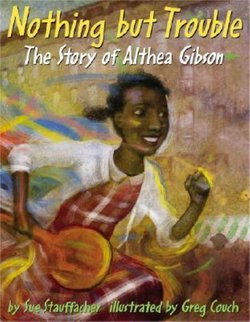
Today TWICE is hosting a day of sessions with author Sue Stauffacher on her book Nothing But Trouble: The Story of Althea Gibson.

Althea Gibson was “the first African-American woman to be a competitor on the world tennis tour and the first to win a Grand Slam title in 1956. She is sometimes referred to as “the Jackie Robinson of tennis” for breaking the color barrier.” – Wikipedia.

This program is an excellent Black History month program because the students get to learn much about the history of the time, as well as the writing process. Sue has a great PowerPoint with historical photographs that show the history and what Althea’s life was like.

Did you know that in Sue’s book Donuthead, the character Sarah Kervick is based on Althea Gibson’s toughness?! Now you’ll have to go read that book again to compare!

Here’s a flavor of the conversations and discussion from these sessions.

  • How do you get inspiration for your books? Usually by accident!
  • We noticed that the colors in the book around Althea Gibson are much brighter in the beginning of the book than at the end of the book. Why is that? The artist was trying to use colors represent how Althea moved from chaotic energy to focus towards the end of the story.
  • Why do you think Althea was so angry and wild? The answer included explaining how great athletes often have a wild streak and the ones that are great are able to harness and focus that energy.
  • What does “nicking sweet potatoes” mean?
  • What is your favorite part of the writing process?
  • How do you overcome writer’s block? I like to do something that uses my hands but not my head. Then I let the question rest in my mind and sometimes the answer comes!
  • What are your favorite genres?
  • In talking about publishing and failed projects, Sue explained to the students that if you want to succeed, you need to expect to fail. It takes persistence and many tries to succeed.
  • On her upcoming TillieRide, she invited the students to write notes to her to tell her how they overcame something. She said I’m scared, but sometimes you just have to overcome your fear!

Sue has a quirky sense of humor, and engages delightfully with the students. We hope you can participate in another session with Sue! There are still openings in the some TWICE ASK sessions with Sue in April if you want to join us!

Need Skype Partner Class – 8th Grade Social Studies

Help! Can anyone help me find another 8th grade social studies class? Here’s what my teacher wants to do:

Dates: February 22 – March 4 (M-F) (negotiable)
10:40 – 11:25 a.m. EST

A Southwestern, rural Michigan eighth grade class, studying the Great Depression, would like to connect through Skype, with a class from a different region in the United States (or elsewhere in the world). The students are interested in finding out how a different region of the United States (or the world) experienced the Great Depression. The Michigan students will PowerPoint to present discussion on the effects of the Great Depression in this part of Michigan.

Even if you could connect and listen to our class presentation it would be great. Please help!

Contact: Arlene Bailey at abailey@andrews.edu

MysteryQuest World Geography and Visuals

This week I have several classes participating in MysteryQuest World Geography. We’ve been facilitating this program since 2002, and it’s always fun to see what the students come up with for their presentations. This week we’ve had fun costumes, interesting hats, and great PowerPoints with clear clues.

In a MysteryQuest, four to six classes share clues about a country, state, or historical event, and then research like crazy to figure out what everyone presented. At the end, we share guesses and correct answers. Students are highly engaged!

I can tell when the students have used the handout to prepare their posters or PowerPoint. I usually prefer to share only good examples, but this morning, one slide was so hard to read that it makes a great bad example!

Can YOU read the area of the country from this slide?!

You can learn more about MysteryQuests here:

You can also read previous posts about MysteryQuest World Geography:

I hope YOU can participate in an upcoming MysteryQuest or HistoryQuest!

TWICE ASK Author: Bessie Smith and the Night Riders

Today TWICE is hosting an awesome ASK program with Sue Stauffacher on her new book, Bessie Smith and the Night Riders.

Sue is a wonderfully funny author and students really enjoy her books.

Bessie Smith was the “Empress of Blues” and stood up to the KKK at a concert. This picture book tells that story, and during the session, students learn more about the historical setting and history of her story, while learning about the writing process as well. It’s an amazing program!

Here are some of the questions from today.

  • Bessie Smith is a blues singer. Are you a fan of the blues and who are your favorite blues singers?
  • In the book, Bessie is dressed up with fancy clothes. Did she really dress like that? Sue had great pictures to show when answering this question.
  • If you were a character in the book, would you be like the girl who stood behind Bessie or would you be like the boys who ran away?
  • Are the songs in the story real, and how did you choose them?
  • Are there other events in Bessie’s life that you considered writing a story about?
  • What was Bessie Smith’s favorite place to perform?
  • Do you think the KKK still exists today?
  • What gave you the courage to write your books?

Sue Stauffacher loves the ASK program because of the depth of questions and discussion with the students. She also helped students understand the revision process and how challenging it is, and how she moves through the process. It’s partly in your attitude – being willing to make something you like even better!

By the way, there are still openings in the some TWICE ASK sessions with Sue in April if you want to join us!

Videoconferencing is "REAL"

As many of you know, I’m currently teaching an online class – 21st Century Communication Collaborations.

One of the participants in the class is doing Weather Buddies – a year long collaboration with a Dallas ISD class. She described a serendipity moment during their last VC:

In our weather buddies vc my class had written a brief story about a snowy day. We had read the book Snowy Day by Ezra Jack Keats. Several students read their writing to our weather buddies. The media specialist in Texas found the book and gave it to the teacher there during our vc.  My class was so excited to see the very book that we just read. The kids there had made a connection with us and our writing. This was not planned it just happened. I can’t wait to see what they thought of the book!

One of the other participants has not yet done VC with students – and has only experienced Skype with family. This was her response and reflection:

Thanks for pointing out the “realness” that VC allows when you talked about the writing and book connection. Today, walking outside after the snowstorm, a strong feeling of what is real came over me – being outside, interacting with people (my neighbors helped me dig out), my dog trotting, etc.

In the last few years I have increasingly felt that technology is not real – it is somewhat artificial – it doesn’t breathe, think or have emotions and even many projects we do with it, aren’t completely real.

So, your example caused me to think – VC breaks through the artificial aspect of technology – people are real – you can see them, talk to them and feel with them.

Have you experienced this too? Have you noticed how videoconferencing can help you feel so close and connected to students and people so far away? It’s an incredible power to the technology!

Share a story if you too have felt this!

How to Find International Partners

This is an update of a previous post from six years ago! Time to refresh!

So, you want to connect with an international school for a videoconference. Now what do you do? Here’s how I find international partner classes for my teachers.

First, think about times

Before you even start looking for a partner, do a self-check.

  • What time zone are you in? (www.timeanddate.com is a great site for help with time zones!)
  • Are you willing to connect outside of your school hours?
  • If you are willing to connect outside of school hours, how far outside of school hours? Will you have a slumber party at school? Can you only do evenings? Can you do early mornings?
  • If you are not willing to connect outside of school hours, you will need to look at time zones to find the countries that are in session at the same time as you are in session. Do NOT approach an international school and expect them to connect outside of school hours. That is very inconsiderate! Often there are safety and transportation issues for students at international schools to come back to school in the evening.

Then, get on timeanddate.com and get familiar with the time differences between your location and your desired connection location. See if you can figure out ahead of time what will work best.

Second, what do you want to do?

National collaborations between classes are hard enough if your idea is ambiguous. International connections are even more so.

You will get a much better response if you have a very specific idea of what you want to do and when you want to do it (date & time defined but negotiable is best).

Also, make sure that your plans are sensitive to the other country/culture. For example, one of my teachers once wanted to do a collaboration on the U.S. Revolutionary War with the U.K. Well, I know from previous collaborations that the U.S. Revolutionary War isn’t in their curriculum the same as ours. So be sensitive and thoughtful. Think about the content from their perspective if you can. Make sure your plans are open to negotiation as well.

Now, hunt for an international partner

  1. Search CAPspace by country. Don’t post a collaboration looking for an international connection. There are tons of U.S. educators who don’t need the email. Instead, Search People by country. Get their email address and email them directly with your proposal/idea.
  2. Search CILC by country. Go to Videoconference Directories, search by country name in the keyword field. Get the contact email address and email them directly.
  3. Network. Meet people where ever you can! Some places to start include Megaconference Jr., ISTE, and ISTE’s SIG IVC. The more people you meet doing VC, the more connections you make and the more you share collaborations. I carefully save contact info for everyone who emails me and keep folders for states & countries where I know someone doing VC.
  4. Listservs.Megaconference Jr. has a listserv, and even though Megaconference is no longer happening, there is a vibrant community on the listserv (mostly higher ed but they can get you K12 contacts). In addition, on the megaconference websites you can find lists of participants. Just google their school, hunt around on their website, and you can usually find the VC contact person’s email address.
  5. International programs. Did you ever notice you can search content providers by country on VCContentProviders.org? Also when participating in global programs such as those from Global Nomads and Global Education Motivators, you often connect with classes from other countries and therefore can meet and collect contacts that way.

Note: These sites are for advanced H.323 videoconferencing. You can find more sites for Skype here.

Maximize A Response

Now, before you send that email, double check to make sure you have increased the likelihood of getting a response:

  • Did you include a suggested date & time in your time zone AND their time zone?
  • Did you let them know you are flexible on the time?
  • Did you detail specifically what you want each class to do? Did you indicate that you’re willing to negotiate this part also?
  • Is your message easily readable, scan-able, and clear?

Finally, be patient and persistent!

Your Turn

  • What tips would you add?
  • What successes have you had?