“As a media specialist, I think this course would be extremely useful for my teachers and staff.”
“This is actually the first on-line course I’ve taken, and I am quite impressed. Obviously you’ve put much time and thought into these materials and methods. I got a number of good ideas and insights from the other participants’ postings and replies to posts. Discussion of this type is a key to understanding and internalizing new information.”
“The information presented was all very useful. The contacts made with other schools around the country will be a very valuable resource to tap in the future as will some of the content provider sites.”
Recently I’ve been reading about Differentiated Instruction. It’s one of those things that I hear alot about, but needed to really learn so I can connect my instructional technology practice to the current pedagogical practices teachers are learning.
60 minutes guest speaker time (GNG and other content providers or guest speakers)
30 minutes “local time”
60 minutes small group time (groups meet across sites)
30 minutes “local time”
Solving Math Problems
What is Local Time? Local time gives the participants a break and includes the following:
Housekeeping time (reminders, signing up for jobs, etc.)
Instruction on Skype and GoogleDocs
Instruction on finding VC programs
Video clips
Optional activities such as learning Twitter or Glogster
Debrief and reflection time
Why Differentiated Instruction?
We continue to struggle to assist new facilitators with local time. Those of us who have taught Jazz for a long time have a sense of where the participants are, what their needs are, and we adapt and are flexible throughout the week.
New facilitators are overwhelmed by the choices and find it hard to know where to start.
Differentiated instruction includes
differentiating content (materials and mechanisms)
differentiating process (activities)
differentiating product (ways students demonstrate learning)
As I read about differentiated instruction, I realized that in Jazz, we differentiate instruction in two major ways:
We scale the activities and responsibilities for new facilitators.
We adapt the local time activities based on the needs of the participants.
So what’s new?
I realized that some new facilitators (and veteran facilitators) may not be familiar with the instructional tool of adapting instruction to participants needs or being flexible in training. So, I made a little overview of differentiated instruction for our facilitators that we can use each year during our planning meetings. It includes:
A quick overview of Differentiated Instruction
Picture examples of differentiated instruction in action
Prompts to think about assessing participants
Items to decide and plan for local time
Your Turn
Jazz facilitators, what do you think? Will this help us? What did I miss? Is it too complex? Understandable?
Past Jazz participants: did you ever realize that what happens during Jazz looks like differentiated instruction? What connections do you see?
Last fall I attended an evening concert/lecture with Jazz Impact at the Banff Centre. I reflected then on the connections between jazz music and the 123 VC: Jazzing Up Your Curriculum with Videoconferencing. Today, as part of my Leadership PhD program, I’m attending an all day workshop with Jazz Impact. The lessons are still striking and applicable to the Jazz Workshop. So I write again, this time challenging those facilitating Jazz next week to reflect with me!
Jazz Lead Facilitators Meeting
There are five themes that make jazz music work:
Autonomy
Passion
Risk
Innovation
Listening
So here are some questions for you to think about your own participation and contribution to the “music” of the “Jazz workshop”. If you aren’t facilitating Jazz next week or participating, use these questions to think about a group of people you collaborate and work with.
Autonomy
Where do you have autonomy within the Jazz workshop?
How is your autonomy moderated/tempered by the relationship and dependence on the group?
Passion
How do you feel a sense of purpose in your work in the Jazz workshop?
Do you feel a sense of emotional commitment to the success of the workshop? (It’s the emotional commitment of the individual that sustains the strength and integrity of the organization as a whole.) So how are you emotionally committed to Jazz? How did you get emotionally committed to Jazz? What inspired it?
Do you feel that your potential and your voice is heard in the planning and implementing of the Jazz workshop?
Risk
Where is the uncertainty in the Jazz workshop?
How are the guidelines of our score simplified so that everyone can improvise from it? In Jazz, the score is simplified so that improvisation can occur around it. (Compare a classical score to a jazz score: the key, 8 notes, the time. That’s it!) Have we simplified the score enough to allow for appropriate improvisation based on the needs of the participants?
Think “local activities”. Are they simple enough to allow for improvisation yet enough structure for the new facilitators? The construct of a jazz tune is: the tune, zone of improvisation, the tune at the end.
Do we have enough uncertainty? Does our “organization culture” allow for “competent mistakes?”
Innovation
Innovation is a relationship, a social function. How are you contributing to the innovation? How is the relationship with other Jazz facilitators inspiring your own innovation?
There’s a cycle of new musical ideas to structural foundation, to create new musical ideas to expanding the structural foundation, to expanding the musical ideas – i.e. a cycle of VC ideas, to a structural foundation – the basic structure of the Jazz workshop, to getting new VC and Web 2.0 ideas, to expanding the foundation, to getting even more ideas. Where are you in the cycle? Are you improving and expanding the ideas? Or are you improving and expanding the structure? or both?
Vicki Listening
Listening
Listening is a verb that generates cooperation. How are you listening to your lead facilitator? How are you listening to the other facilitators? How are you listening to the participants in the workshop?
Do you listen defensively, and only hear what you already know? Or are you able to listen with empathy to hear the new ideas from others?
Life is an echo – what you send out comes back. –Unknown
This year I can’t attend NECC due to a family conflict, so I’ll be trying to catch a taste of the action online. I thought I’d start today with a list of IVC and videoconferencing related sessions that I could find on the schedule.
Recently I’ve been learning about situated learning. Here are some thoughts connecting situated learning to Jazz.
Roxanne Glaser, lead facilitator Mentors Christie Rickert, first year facilitator
Lave and Wenger (1991) in their book Situated Learning describe learning within a situation, within a community, as situated learning. A key component of situated learning is “legitimate peripheral participation”, which means that newcomers to a world of knowledge or skill begin by participating with an old-timer (expert learner), and by virtue of that peripheral participation they grow to become an old-timer. The peripheral participation is legitimate in that the relationship is either formalized (i.e. apprentice) or informally understood by expert and newcomer.
Jazz Lead Facilitators Meeting
In Jazz, 5 lead facilitators each mentor a group of 3-4 facilitators. The lead facilitators organize the activities, delegate tasks such as leading a simulation, preparing materials, and mentor the facilitators in best practice. The work of preparing for the workshop and delivering the workshop is accomplished together. This way the newcomers have “access” to the old-timers and learning occurs as the work is accomplished. Preparation for the workshop includes several meetings beforehand where we walk through the each part of the workshop. During the workshop, newcomers may lead a section, with the lead facilitator on hand in case questions arise. After each day, the facilitators debrief with their lead facilitator. As we talk through how the day went, each facilitator is learning, reflecting, and refining their training practice.
Lave and Wenger suggest that in a learning community, there is a set of relations between the newcomers and old-timers through the cycles of learning. “The community of practice encompasses apprentices, young masters with apprentices, and masters some of whose apprentices have themselves become masters” (p. 57). The learning occurs across the layers of relationships, between near-peers, and across learning cycles (See Figure 2). Within the Jazz Workshop, the knowledgeable skills in facilitation, technology training, and collaborative technology tools move in and across each circle of learning. Everyone contributes to the continual improvement of the workshop and therefore our continued practice of implementing videoconferencing in the curriculum.
Another key component of legitimate peripheral participation is that participation is at first partial, and grows in scope and complexity. A new facilitator often is overwhelmed with the complexity of the workshop and the details to attend. The lead facilitator at first gives the new facilitator simple tasks, such as an introduction to a simulation or a debrief of a simulation using a PowerPoint overview already created. As the new facilitator gains in skill, and relationship builds that the lead facilitators see the skills, the facilitator begins to contribute knowledge, handouts, resources, to improve the quality of the workshop. As they learn the components of the Jazz workshop, they learn the culture of Jazz, the ways we integrate videoconferencing in the curriculum, and the foundational beliefs of constructivist learning and collaboration.
Small Groups Meeting
In the first year of facilitating Jazz, the newcomer is getting the big picture or broad view of what the workshop is all about. They have strong goals to learn how the workshop runs. Yet after they have the big picture, the learning can occur rapidly between peers and near-peers as the facilitators compare notes and learn professional development techniques from each other. Lave and Wenger suggest that the effectiveness of the circulation of knowledge among peers may be a condition for the effectiveness of learning (p. 93). Web 2.0 tools such as Skype chat, facilitator blogs, running conversations throughout the year on Twitter all contribute to the circulation of information and knowledge within the Jazz learning community.
What do you think? Are you in a learning community that includes situated learning?
Just received the evaluation data from the June Jazz workshop last week. The feedback was overwhelmingly positive. All 72 participants said they would recommend Jazz to another teacher. I thought one of the open-ended questions on the evaluation form would make a great Wordle.
Please describe the most valuable experience you feel that you had while participating in the 123VC course.
Nice collection of words, isn’t it!? If you participated in Jazz before, feel free to comment with your interpretation.
In Jazz this morning, as we were debriefing from the week, the middle school and high school people really wanted to do MysteryQuest in one class period. Their class periods are 55 or 60 minutes. We brainstormed how it could work:
New Schedule
4 groups x 5 min presentations = 20 min. for group presentations
15 minutes for research (can use computers from the start)
SKIP the Q&A and re-evaluate to increase the pressure, make it harder, and make it shorter
5 min. sharing guesses
5 min. sharing answers
45 min total with 10 minutes lee-way for technical difficulties and transitions.
Tips for shorter preparation time:
all the sections do the same city/country
use the same visuals (posters/PowerPoint) for all the sections
Transitions
put in the prep materials some tips for making fast transitions
know the schedule and have kids up at the mic ready to go
when you’re about to present, have some kids taking notes and the others getting ready to go
Whew! What an amazing week of Jazz June 2009. I love this workshop – everyone learns so much! In the words of one of my participants:
I feel very fortunate to be a member of this workshop. It’s like summer camp for adults, and the best part is, our “summer camp” travelled from state to state and overseas!
Well, I must say that I was very intimidated by technology in general. At the beginning of this week. I just thought that I would learn about vc and still let the librarian run the vc’s like in the past. Well, I am excited to say that thanks to Janine, I really will set up the vc. Actually, I have about 8 scheduled for next year. Thank you so much Janine for taking away my vc anxiety and introducing me to so many other online things.
Our roll calls today were just hysterically fun! We had fun cheers from each of the sites. We used @sparky1fan’s Cheer video clips and ideas to prepare.
We had a great time with MysteryQuest Beaches this morning. Everyone shared clues about a beach in their area. We had some very creative presentations, including clues given by Jhiymy Mhiyles, the Bondi Beach “caveman” in Australia (under the “table house”).
We also had a major tech glitch in the middle of one of the presentations. My bridge rebooted and we lost Internet in our room. But after 5 minutes of panic, we were back up and running again and kept going.
Guest Speaker: Global Nomads
The Global Nomads Pulse simulation on Wed is always a highlight of Jazz for me. We tackled the tough issue of the economy with a discussion of questions such as:
What would be a possible solution to the global economic crises?
What other areas or issues have been impacted by the economic crisis?
What changes have been made in your school due to the economic crisis?
Small Groups
Small groups worked hard on writing their lessons today. Heard lots of good ideas and look forward to those projects being online.
One more day of instruction and simulations; then sharing projects and the celebration. Love this workshop!
2nd day of Jazz all done! Here’s a few thoughts & comments:
Roll Call
The roll call was really fun again this morning. Wales led it, and waved their flags and wished us “bora da” (good morning in Welsh). Everyone shared their weather forecast for today and the rest of the week, and we shared it in F and C so that Wales could understand the numbers. OH was very creative and included a song and dance!
Finishing up Read Around the Planet
Yesterday Wales left us early because they had a thunderstorm that knocked out their power. So this morning we took a few moments to hear their Read Around the Planet exchange presentation from yesterday. They shared a very cute puppet show of the story of Billy Goat Gruff and the Baby Troll, complete with puppets and a backdrop!
Math Marvels
For simulation time today, we solved math problems for Math Marvels. One of the problems involved tomatoes. As we gave the answers, we heard three different pronunciations of tomAtoes, tomahtoes, and tomaters.
Q&A with Wales & BC
Two of the participants in Wales led our Q&A time. We did a round of asking questions with Wales. Each site asked two questions and then Wales asked them two questions. Then we did another round the same way with British Columbia.
Nice set up of questions modeled by Dallas – I’m ___ from ____ and in our area _____, what is ______ like in your country?
Everyone really enjoyed the conversation time with Wales & BC; and we learned about how to ask good questions.
Guest Speakers
Our guest speakers were NASA DLN (Stennis) and the San Francisco Giants. We had a nice taste of the programs and got a flavor for how interactive their programs are.
Behind the Scenes
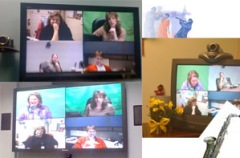
It takes a lot of work and techncial expertise to pull off the connections for the Jazz workshop. Shane, award winning bridge dude at Region 12, TX bridges 8 sites together for guest speaker time. Look how many monitors it takes. The skype chats are for the facilitators to give feedback to Shane or solve problems.
Groups are working well together – there are 11 total groups across my four sites. Looking forward to some great projects on Friday!
This year instead of just a video/audio check in the roll call at the beginning of simulations and guest speakers, we beefed up the roll call with more content. Monday we share our location; Tuesday weather; Wednesday a cheer or clap; Thursday local trivia; and Friday what we learned.
I loved the roll call this morning. Each site had fun visuals about their area as well as a map. I loved the cowboy hat from Hays CISD TX; and the buckeyes from OH. This is a great addition to this workshop!
Exchanges
In the first simulation participants experience four types of exchanges: Read Around the Planet, Animal Exchange, Community Exchange, and Monster Match.
I have four high school English teachers who want to VC with Wales for British Lit. They did a Babbles with Bard game show and quizzed our Wales partners on Shakespeare quotes. Very nice! My animal exchange group didn’t just present an animal – they made clues for the other group to guess the animal! Nice modeling of more interactive exchanges. I’m glad to see examples of more than just “presenting” but also actually interacting and engaging the partner class.
Guest Speakers
Our first guest speaker was Andy Campbell at LearnNCO. His “gross science” is always a hit with the teachers.
James Tapankov shared The Seven Things. At a minimum, have everyone: Move. Write or Draw. Talk. Share.
Connections
At least in this June session, we made a concerted effort to have less bridges in the call. The guest speaker time, with all 8 sites connecting together, we used just two bridges – my Tandberg MPS bridge with 4 sites; and Lori’s group on ESC12’s Codian bridge with 4 sites.
The connection quality with guest speakers is gorgeous this year! (so far).
Whew! A great day, and mostly happy people seeing the possibilities for their curriculum!





 Whew! What an amazing week of Jazz June 2009. I love this workshop – everyone learns so much! In the words of one of my participants:

 We had a great time with MysteryQuest Beaches this morning. Everyone shared clues about a beach in their area. We had some very creative presentations, including clues given by


