MysteryQuest and HistoryQuest Registrations Open

Registration is open for the following “quest” events. The sessions are $35 each. You’ll need verified equipment in CAPspace to register. I can walk you through it quickly if needed. Just email me.

MysteryQuest USA

This project is designed for 4th or 5th grade students studying US geography. Through video conference technology, students are able to meet other students while learning about cities and states in the United States. Prior to the video conference each classroom will create a presentation with clues about their state and city. The other classrooms, using maps, the Internet, textbooks, and other resources, will try to discover the mystery location presented by each participating classrooms.

MysteryQuest World

(Asia, Americas, Middle East and Europe this year)

This project is designed for middle school students studying world geography. Through video conference technology students are able to meet other students while learning about cities and countries in the world. Prior to the video conference each classroom will create a presentation with clues about their ONE mystery country and city. The other classrooms, using maps, the Internet, textbooks, and other resources, will try to discover the mystery location presented by each participating classrooms.

HistoryQuest5: Beginnings to 1800

This project is designed for 5th grade students studying US History. Through video conference technology, students are able to meet other students while learning about United States history.

Prior to the video conference each classroom will create a presentation with clues about a mystery person, event, invention, issue/problem or section from a document. The other classrooms, using maps, the Internet, textbooks, and other resources, will try to discover the history mystery presented by each participating classroom.

HistoryQuest8: 1754-1898

This project is designed for 8th grade students studying US History. Through video conference technology, students are able to meet other students while learning about United States history.

Prior to the video conference each classroom will create a presentation with clues about a mystery person, event, invention, issue/problem or section from a document. The other classrooms, using maps, the Internet, textbooks, and other resources, will try to discover the history mystery presented by each participating classroom.

Hope you can join us this year! Let me know if you have any questions or difficulties.

Shadow Puppets for Read Around the Planet

Still continuing our Read Around the Planet connections this week. Today two classes from River Valley Middle School are connecting to South Carolina and Virginia. The 8th grade students have been studying the book Anne Frank. Recently they did the Anne Frank program with the Center for Puppetry Arts.

Shadow PuppetsBased on that inspiration, they shared two shadow puppet plays that the students wrote. The play came across really well in the videoconference. In addition, a couple of groups also shared their rap written about Anne Frank. Our partner class really enjoyed the puppet shows.

Still another 23 Read Around the Planet connections to go!

Video Interviews

While I was out in Nebraska a few weeks ago, John Stritt, Distance Education Director at ESU 10 interviewed me for their video podcast series. There are three little clips, very professionally done.

Feel free to use these in your training sessions.

New VC Content Providers Website & RSS Feed

Announcing……


The Berrien RESA / Polycom Videoconference Database is moving to a new home! We have a new URL, new server with more capacity, and new features.

Please update your links to www.VCcontentproviders.org. Update your links to the “Two Page Selected List“, the Search Help Page, and the Content Provider List too.

New Features

  • We no longer have the 100 user limit we hit last year (a FilemakerPro limitation).
  • You can subscribe via RSS or email to the new programs (see the links on the left here).
  • Content providers can now edit their own pages. But we will continue to scour the web for every possible VC program we can find and list.

New Programs on Your Website
If you would like, you can copy and paste this HTML code onto your website, and the most recent 5 programs added will show on your page.

<script src=”http://feeds2.feedburner.com/VcContentProvidersNewPrograms?format=sigpro” type=”text/javascript” ></script><noscript><p>Subscribe to RSS headline updates from: <a href=”http://feeds2.feedburner.com/VcContentProvidersNewPrograms”></a><br/>Powered by FeedBurner</p> </noscript>

Thank you for updating your links, as the old site will go offline the end of March. Let me know if you have any questions or comments.

Conner Prairie No Longer Offering Programs

I received word in my email this morning that Conner Prairie in Indiana is discontinuing their distance learning program. They have won either the Teacher’s Choice Award or Honorable Mention in the last three years of our annual spring survey.

The explanation given was partly due to the rapid downturn in the economy.

I’m sad to hear this news, and I hope that they are still able to provide history lessons to those who come onsite to their museum. It’s a reminder of how subsidized and sponsored the content providers’ programs are. If we in education want videoconferencing content in this manner, we should be willing to contribute to the cost of development and delivery. But sometimes even that isn’t enough to keep the programs going.

We’ll miss you, Conner Prairie!

Did you ever connect to Conner Prairie? Which programs did you like? Feel free to comment.

ESL Read Around the Planet

After the first week of so many Read Around the Planet connections along with other VCs, I finally was able to actually watch a full session today. We have 63 RAP sessions this year.

Read Around the PlanetToday’s session was an ESL Read Around the Planet. We started by our 7 students saying their name and hello in their native language (Spanish and Korean). Then our friends in TX also said their names.

Our friends in Texas shared a song with us. Then our students taught the kids in Texas the alphabet using ZooPhonics with actions. Our class sang about the animals that live at the zoo.

Read Around the PlanetOur friends in Texas shared the beginning of a book about an animal in the zoo. Then they shared a song about colors, with each student representing different colors.

Some of the questions the students asked each other were:

  • What is your favorite food?
  • What is your favorite book?
  • What is your favorite toy?
  • What kind of weather is it there?
  • Why aren’t you wearing blue? (one class had uniforms and the other class didn’t)

The students enjoyed a great conversation and learned about each other. Reminds me why I love this project!

Is videoconferencing "enrichment"?

I just finished reading Eric Jensen’s book, Enriching the Brain: How to Maximize Every Learner’s Potential. Eric Jensen is a leading educator in the area of applying neuroscience research to practical classroom applications.

As I read, I kept reconsidering my reluctance to use the word enrichment in talking about videooconferencing. I prefer “curriculum videoconferencing” to emphasize the use of VC to meet curriculum goals. To me, enrichment sounded like an “extra”, like something expendable in high-stakes, tight-budget times.

What is Enrichment?
But then, all through the book, I kept encountering Jensen’s insistence that all students need to experience enrichment. What does he mean? First, it’s important to understand his definition:

Enrichment is a positive biological response to a contrasting environment, in which measurable, synergistic, and global changes have occured (Jensen, 2006, p. xii).

A careful read of the book shows the importance of understanding that enrichment is the response to a contrasting environment, not just decorating an “enriching environment.” Enrichment is what happens to the brain in a contrasting environment. I encourage you to devour this book to understand this fully.

So, what is a contrasting environment?
A contrasting environment is where the student experiences a “contrast” from what he or she is usually getting. There are seven factors or maximizers for contrasting environments. They are:

  1. Physical Activity (voluntary gross motor)
  2. Novel, Challenging, and Meaningful learning
  3. Coherent Complexity (not chaotic)
  4. Managed Stress Levels (not boring or distressful)
  5. Social Support (at home, school, and community)
  6. Good Nutrition (balanced and healthy with supplements)
  7. Sufficient Time (not rushed, plenty of sleep) (Jensen, 2006, p. 178).

Jensen’s suggestions for whole district improvement are way beyond anything that I can impact in my work – eliminating grade levels, 20-30 minutes of recess daily, pull out programs, acceleration, student choice, exploratory learning, social connectedness, etc. He describes a major change to traditional schooling. While it’s inspiring, it’s beyond the scope of my current work at least right now.

Novel and Meaningful Learning
Thankfully, he also has suggestions for teachers and principals. The one that seems to be in an area that I can impact is that of Novel, Challenging, and Meaningful Learning.

  • Have you ever wondered if kids like VC just because it’s novel? Why is it that Monster Match is such a great relief from Michigan state testing and Read Around the Planet relief from NY and TX state testing? Could it be because it’s a contrast from their regular work?
  • Why is it that teachers comment especially on the reaction of special education kids in a videoconference? Why do special ed kids gain a lot from a videoconference? Could it be because it’s a contrast from their regular experiences? Interestingly, Jensen spends quite a bit of time on how at-risk, poverty-challenged kids can benefit greatly and make significant gains in learning when they are in a contrasting environment.
  • Is it actually a good thing for students’ brains that VC is novel? that it connects them to real-world meaningful learning, we agree already. But novel?! I thought that novel was kind of a bad word in education, that an innovation should be sustainable, sustained, institutionalized.

Don’t misunderstand me or Jensen! Short one time VCs are hardly a drop in the bucket of the contrasting environment that students need. Be sure you understand the huge scope of what he is suggesting.

Still, I think we can take away a small application by understanding that the novelty and real-world connection of a curriculum-based videoconference is stimulating to students’ brains! (Talking to an author, talking to kids in Australia, Canada, or Wales, interacting with scientist… that’s all real-world.) Probably not enough to make a significant (countable, measurable) difference; but yet another little tool in the teacher’s arsenal of tools for creating a contrasting environment for students.

What do you think? Have you read Jensen’s work? Am I off base? Is it too much of a stretch to apply this, even in a small way, to the use of videoconferencing? Are you going to use the word enrichment or “contrasting environment” when describing VC? Please comment!

Mexican Dances

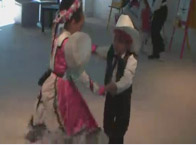
Mexican DancesToday we have a couple more sessions with Frank Garcia at the Pedro Zaragoza Foundation. Today’s classes were middle school exploratory language classes. They were treated to several dances, interspersed with some question and answer time. Our students asked:

  • How old were you when you started to learn the dances? (5 years old)
  • How long does it take to learn the dances? (about 3 months)
  • What time is it there?
  • Is it hard to learn the dances?

The students in Mexico asked our students:

  • What are your names?
  • Do you want to learn how to dance?
  • What kind of music do you like?
  • If it’s cold, why aren’t you wearing sweaters?

I would like to think of some more ways the students could interact and do some games. Maybe they could teach our students some simple steps or some vocabulary. I would like our students to be able to share something too, that would be of benefit to the orphans.  What ideas do you have for interacting?

Leading Through Collaboration Book Review

Continuing work on my 5th competency:  Servant Leadership in Technology Facilitation and Collaboration.

Glaser, J. (2005). Leading through collaboration: Guiding groups to productive solutions. Thousand Oaks, CA: Corwin Press.

Summary
Glaser (2005) sees a leader not as a head of an organization, but anyone who watns to help bring solutions to problems. His book is written to give leaders the tools to develop attitudes and skills to “align the organization around learning” (p. ix). In part 1 Glaser emphasizes attitudes. While some may be tempted to skip to the part 2 skills section, his writing on attitudes about coherence, the self, shared meaning, and groupthink lay an important foundation. From there, the skills section teaches the fundamentals of aligning the team, focusing on the vision, finding solutions, and agreeing to the solution. Filled with stories and real-life examples, this book will inspire you to improve collaboration skills beginning with the next problem you have to solve!

Initial Reaction
I didn’t get very far into this book before I was surprised at the focus on conflict, conflict management, and listening for agreement and disagreement. I’m not sure what I expected, since I collaborate with others daily. But I was not prepared for the focus on getting past disagreement and conflict. But on reflection, clearly you can’t have collaboration without strategies to address conflict and disagreement appropriately. After reading the book, I feel that I have very few, if any, of the skills listed, yet I do collaborate with others. I believe that as I am able to implement what I’ve learned, my collaborations will be stronger and more respectful of others’ views. Not just respect, but actually incorporating all the views and needs of others into the solution. I wonder if sometimes my Strategic strength jumps to a solution without full participation from the group.

What is Collaboration?
Glaser (2005) begins with a definition of collaboration: “to work together to solve a problem or create something new” (p. 3). In addition, he defines coherence as “the condition that exists when individuals are aligned on a given subject or task, and are ready to harness their collective energy to move forward on a common ground solution” (p. 3). As I consider these definitions, I am evaluating my own collaborations.  Just for reference, here are a few of them:

Glaser (2005) suggests that effective teams have the following qualities:

  • joint commitment to shared goals
  • trust of all members to understand their roles and get the job done
  • shifting leadership based on task and circumstances
  • excellent communications
  • understanding each other’s needs and perspectives
  • a sense of humor
  • willingness to set aside differences and to work together for the greater good (p. 4).

The Jazz workshop certainly has this. The one area where we have to work hard to make it happen is the communications, because of the physical and technical distance between us.

Things to Learn

  • The first and main lesson for me from this book is listening. Not just listening to understand, but listening to detect coherence. Glaser told a story of hearing a group discussing who thought they had disagreement, and he asked permission to summarize what he heard, and everyone agreed (p. 9). I want to fine tune my ear to hear like that! In addition, Glaser describes a teacher listening “openly and attentively” to a complaining parent, even when the complaint is presented emotionally (p. 114). I want to be able to listen openly and attentively instead of getting “riled up” along with the other person! “A power leader and problem solver should cultivate an ability to inquire deeply into the nature of what motivates people” (p. 118). This means being able to understand an issue as others see it. Again, later in the book, Glaser (2005) emphasizes listening for the common ground… listening carefully and constructively. “A powerful, consensus oriented leader will develop an ear for how different perspectives fit together, focusing on areas of agreement versus separateness” (p. 143).
  • Another important lesson is to pick up the phone and “call each other before small organizational rubs become huge conflicts” (p. 16). It’s too easy to write an email or Skype message when a phone or VC would resolve the issue and maintain the relationship.
  • Define the problem is another principle from the book. Information needs to be shared so that all understand the ramifications and have shared their perspectives. The work needs to be addressed against the problem, not against each other.
  • Aligning the team includes setting up the meeting to focus on the problem, not on fighting each other. The book includes several suggestions on chair placement, focus of the room, etc. to help with them.
  • Be firm and flexible at the same time! I need to learn to be firm in “articulating and identifying the nature of our interests, while remaining flexible about how those needs get met” (p. 112). This is an important key to true collaboration – meeting the needs/interests of everyone in a creative way. The book has several suggestions for clearly communicating interests, as it is so important to understand the “why” behind the person’s position.
  • Knowing when to push for agreement. Glaser describes several techniques and tools for bringing a group to a solution and/or closure on an issue. These helpful tips include asking each person to articulate that they can support the solution.

Leading by Consensus

Page 175 has a nice little chart with the checklist for what it takes to lead by consensus:

  • Demonstrate leadership commitment
  • Develop a vision and keep it in focus
  • Attend to relationships
  • Maintain open and collaborative communications and problem-solving mechanisms
  • Structure the organization to deliver what is promised
  • Remain mindful of the learning

The book ends with a detailed summary on how to accomplish each of these goals. I found this book very helpful and inspiring and will definitely refer to it as I continue to collaborate with others.

Cross References

  • Learning from this book can be used in my reflection paper for the Communication competency, as well as the Ethics competency.

Favorite Author Quote

08-02-05trapped.jpgToday’s the first day of Read Around the Planet. I had 9 RAP connections and didn’t get to see any of them! They did all work, except for one that will be rescheduled due to circumstances at the partner schol.

I’ve been monitoring/watching our ASK programs with author Eric Walters on his book Trapped in Ice. I blogged it last year. We’ve had a great set of questions and stories today. My favorite quote today though is:

Did you hear about the new TV that’s out that is on 24 hours a day and you can pick whichever channel or show you want to watch. It has a keyboard and you can change the ending of the story. …. No I’m kidding. That doesn’t exist. But it does – it’s called writing and reading!

I paraphrased somewhat, but you get the gist. Eric has a strong message about writing and reading and learning about history. This is our second year partnering with York Region School District Board to share these programs, and we plan to continue for sure.