Tag Archives: ASK Programs

Interviewing World War II Veterans

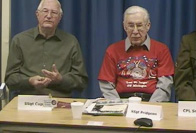
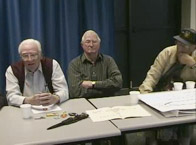
08-03-13veterans1.jpgThis afternoon I spent another hour with our World War II veterans and three classes as part of our Lest We Forget series. While we get less questions in with a panel format, I think the varied perspective from the different branches of the military, as well as both the Pacific and European fronts, provides a broader understanding to our students. I also like the interaction among the veterans as they share their stories. I think the pictures I captured today give you a little of the idea.

Here’s a sampling of the questions from the students today:

  • What was your first day in the service like?
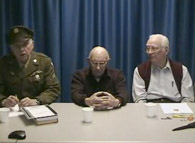
  • 08-03-13veterans2.jpgI’ve read a lot about General Patton. I know many men admired him. How did you feel about him and the men you served under?
  • Before Pearl Harbor we were neutral. Do you think we should have gotten involved earlier? This was a misconception that our veterans clarified for the students. One of our veterans helped prepare supplies for the war before Pearl Harbor.
  • Do you think we were prepared for the war when we entered it?
  • I’m sure you were sad when your friends were dying. How did you feel when your enemies were dying?
  • What was your reaction when you heard about Germany’s surrender?
  • What was your favorite part of the service? Coming home! You should have seen them all light up with smiles at this question!
  • What weapon do you think was the most influential in the war?
  • Do you think the film Pearl Harbor is historically accurate?
  • What were the living conditions like during the war? One of our veterans has a story of how the kangaroos knocked over their tents at night in Australia.
  • What kept you going through the war?

Each session with our World War II veterans is more poignant than the last. After the session, we reminisced about one of the panel members who is no longer with us. It was hard to say goodbye, wondering who would be missing at our next session in December. Yet they appreciate the opportunity, and so do the students. It’s so important to keep telling these stories. The veterans are grateful for young people’s interest in history.

ASK Author: The Ultimate Gift

This afternoon we have several classes participating in two sessions of ASK with author Jim Stovall on his book The Ultimate Gift. The students have prepared using the ASK process. This program is one of the Polycom Special Events, with bridging provided by Arnie Comer at Macomb ISD. The depth of questions and interaction is always incredible. Here’s a sample of the questions:

  • It seemed like Jason was blind to all the gifts he had. Did you do that on purpose?
  • Since it’s voting day in Texas, if you were president, how would you bring the gifts to the White House?
  • If you had one day left, what would you do?
  • How did you figure out the top twelve books in your book?
  • What is the worst problem you ever had and what did you learn from it?
  • Has being blind made any part of your life easier?

After the first session, I talked to one of our teachers who was SOOOO excited about the videoconference. She totally loved it! She said that her students thought Mr. Stovall was so nice and easy to talk to. In addition, she said the book and interview made a significant impact on the “troublemakers” in her class. They loved the book!

Polycom has offered this program every year for the last couple years, and probably will continue to do so. So watch their website for registration details. They have openings in other similar programs too.

ASK Author: Belinda the Ballerina

Today we have two classes participating in Polycom’s Special Event ASK program with Amy Young. The students read Amy Young’s book Belinda the Ballerina and prepared for the conference using the ASK process.08-02-29belinda2.jpg

Amy Young started by reading the book to the students.

  • Did you take ballet?
  • Why did you give Belinda such big feet?
  • Why did the judges hate her and the customers loved her?
  • How many times have you been to Paris?
  • Why did you quit being a lawyer?
  • What is your favorite book of the ones you wrote?
  • Did your first job inspire your drawing or writing?
  • Who is your favorite author & why?
  • How do you make a lot of books?

08-02-29belinda.jpgStudents got to see both the draft of the writing as well as the draft of the drawings. This ASK program was unique in that Amy Young is both the author and the illustrator, so students could see the process from both perspectives.

The students also got to hear her new book, Belinda Begins Ballet.

08-02-29belinda3.jpgAmy also had a pair of Belinda’s shoes, which was really cool! The students were very impressed.

This was Amy’s first time doing the ASK program, and she loved it and so did the students! A great experience for everyone!

ASK Author: Trapped in Ice

08-02-05trapped.jpgToday we’ve had four sessions of ASK with Canadian author Eric Walters. This program is the fulfillment of about 3 years of trying to find a book and author or specialist for our 6th grade students who study Canada. I am ever grateful to Gillian Patrick of York Region District School Board in Ontario for partnering with us to make this ASK program a success. We split the cost of the author, and they hosted him at one of their schools, and we shared the sessions between our schools. A great partnership!

The students read Eric’s book Trapped in Ice and prepared for the conference using the ASK process. Eric definitely beat the records of all our other authors and specialists, averaging about 65 questions per session. Incredible!

  • In the book, the children were shielded from bad news. When you were growing up, did your parents not tell you something you wanted to know?
  • How would the story be different if they had a metal boat instead of a wooden boat?
  • What is the most challenging part of writing a historical fiction book?
  • Who designed the cover and how did they do it?
  • Why did you decide to write historical stories?
  • Why did you pick Helen to narrate the story?
  • Do you like your book or do you wish you could go back and touch it up?
  • Do you have advice for us when we’re writing our stories in class?
  • How did you choose and develop the characters in the book?
  • Have you ever disagreed with an editor?
  • Do you have any books with characters based on you?
  • Do you use a graphic organizer to write out your books?

Students learned about the writing process and some Canadian history with many laughs and jokes interspersed throughout the program. I look forward to hearing feedback from my schools and I’m sure we’ll be doing program again in the future.

Interviewing World War II Veterans

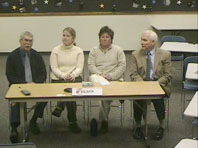
Today we have another session with our World War II veteransWorld War II Veterans, as part of our Lest We Forget series. Today’s session was extra poignant, because we lost one of our usual panelists last week. These moments with our World War II veterans are precious and treasured by teachers and students alike.

After reading Ashton’s blog and looking at her pictures, we decided to include the name tags as she did. This worked out fairly well and our veterans appreciated it. I think I still need a bigger font! Maybe folding lengthwise with landscape will work better than a traditional 2 fold name tent.

07-12-07ww2-b.jpgThis was also our first program with our new blue curtain/backdrop. It’s mobile so we can move it to whichever distance learning room we want to use it in. I also used presets to zoom in on specific veterans instead of using just the shot of the four panel members. I think this presented a better picture for the participating classes.

Here is a sampling of the questions from the students today.

  • D07-12-07ww2-c.jpguring the war, did you know about the Holocaust?
  • What was victory day like?
  • How would you compare your equipment to that of soldiers of other nations?
  • If you have seen any movies on World War II, do you think they did justice to what you experienced?
  • What did you do for fun during your time in the military?
  • Do you ever keep in touch with anyone you were in the war with?
  • What personal items and artifacts did you have with you?
  • Have you ever returned to the site where you served or fought?
  • If you knew someone going into a war, what advice would you give them?
  • How did your families feel about you going into the war?
  • Did you have any plans before the war that had to be changed?

As always, this was a great experience for everyone involved. I recorded it and hope to be able to edit it so that we can share online without the students’ faces. A couple of the schools can’t get parent permission, so we can’t show the whole program. The veterans were very glad that I was recording. After we finished the last session today, I said, “See you in March.” And they responded, “If we’re still alive!” It’s sobering, but they are very appreciative of the opportunity to record and share their stories with future generations.

ASK Specialist: Monkey Island

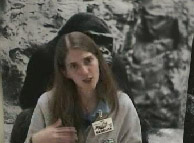
07-11-15homeless.jpgThis morning we have an ASK program in celebration of National Homeless Awareness Week. Students have read the book Monkey Island, and followed the ASK process. They are interviewing a panel of experts who work with the homeless or precariously housed in our county. Here is a sample of the questions:
  • Do kids in the homeless shelter get a Christmas?
  • How can we help the homeless?
  • What are some of the reasons that people become homeless?
  • Are run-aways considered homeless?
  • What is it like to work with homeless people?
  • Are there a lot of children in the homeless shelters? (55% of them are children; the average age of a homeless person is 9.)
  • Where do homeless people go if they are sick?
  • Why doesn’t the government do more to help the homeless?
  • How did you become interested in helping the homeless?
  • What’s the most common race in our homeless shelter?
  • Is there a time limit for people to stay in shelters?
  • Why don’t people want to stay in shelters?
  • What do most homeless people do with their pets when they are homeless?
  • Is it illegal to be homeless?
  • In the book, Clay is scared to go to foster care. What would you say to him?

These programs always emphasize to kids the necessity of a post secondary education and the problems with minimum wage and affordable housing. In Michigan, a person working minimum wage would need to work 104 hours a week to afford a 2 bedroom apartment. In addition, our panelists are always thrilled to see the empathy of the kids and their plans to help the homeless. This is another easy ASK program to copy if you want to get started running ASK programs for your own schools.

First ASK Program of the Year: Ice Bear and Little Fox

07-10-24icebear3.jpgToday we have nine classes participating in our first ASK program of the year, on the book Ice Bear and Little Fox. Students have read the book, journaled, and written great questions, following the ASK process. Four of the classes are from Region 12, TX, as we are mentoring Region 12 in doing their own ASK programs too.
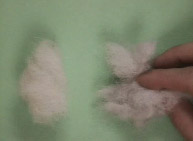
Students are interviewing Rebecca Balk, at the Buffalo Zoo. This is our first 07-10-24icebear2.jpgyear using the Buffalo Zoo for this program and we are delighted with the results. Rebecca is weaving into her answers extra visuals and items to show the students, related to the questions they are asking. She is also great at really quick answers for young attention spans. Sometimes we keep track of how many questions we get in an ASK program, and in the first session this morning, Rebecca answered 32 questions in 45 minutes. Which is quite a record! Since the ASK program is question based and students spend so much time preparing their questions, we sure appreciate authors and specialists who can give concise interesting answers.
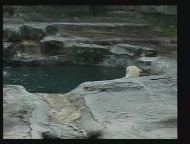
Here are some examples of the students’ questions:

  • 07-10-24icebear1.jpgHow long is the mother polar bear pregnant with a baby polar bear?
  • Does the polar bear have bones in it’s body that humans don’t have?
  • How deep can a seal dive?
  • How long do polar bears live?
  • What do killer whales weight?
  • What is your favorite thing about polar bears?
  • How many polar bears are left in the world?
  • Do walruses attack polar bears?
  • Do polar bears hunt foxes?

If you’re thinking about starting an ASK program, this is a really easy one to start with. Rebecca knows how ASK works; her sessions are reasonably priced; and your schools probably already have the book! So you’d just need to share with your teachers the ASK training materials – linked at the top of the TWICE ASK page.

Polycom Special Events

Polycom is offering a set of free special events this year. You can read about all the details and register here. These are offered through a partnership with Berrien County ISD (for registration) and Macomb ISD (for bridging). Here is a taste of the programs available:

  •  ASK program with author Janie Panagopoulos October 30 and May 1. You can read about a past program with Janie here.
  •  Project Africa, an interview with a student on a service learning project and his published book.
  • Interview with John Porter on the topic of bankruptcy.
  • Interview with Bill Hyche on setting goals.
  • ASK program with author Margaret Willey on her book Clever Beatrice Christmas.
  • ASK interview with blind author Jim Stovall on his book The Ultimate Gift. You can read about a past program with Jim here.
  • ASK program with Ben Carson, author of Gifted Hands and Think Big.
  • ASK program with Sue Stauffacher, author of Nothing But Trouble, the story of African American tennis player Althea Gibson.

Hopefully you can participate! Questions should be sent to Sue Porter.

The Importance of Curriculum Consultants

j0430727.jpg Today I spent the day working with our social studies consultant on various projects. Among other things, we discussed my plans for an upcoming ASK connecting to a Canadian author for 6th grade students studying Canada. The Michigan social studies curriculum is currently under revision, and there is potential that the placement of Canada studies may change. If it does, that will affect the ASK programs I’m working on as well as our MysteryQuest World programs.

In addition, I have an idea for science classes studying the environment, but I want to make sure it’s tightly tied to the curriculum. So in August I’ll be meeting with our science consultant to make sure the project we design is addressing the curriculum in appropriate ways.

I also am in the process of planning time with our language arts consultant to expand the literature circles project that two of my schools did this year.

So my point is, those of us planning and creating content for our schools can not “just dream up something” because it sounds fun. With the pressures of NCLB, state testing, and crammed curriculum, it’s crucial that we do reality checks to make sure the projects we’re designing and supporting fit tightly into the curriculum. Then videoconferencing will support the curriculum instead of being yet another add-on to frustrate teachers with unrealistic expectations.

How do you make sure your videoconferences tightly fit the curriculum?

Students Thank Veterans

07-05-22thanks.jpgToday we have the second day of interviews with our Vietnam Veterans. Today’s Lest We Forget session is for high school students and students have prepared by studying the Vietnam War and in most cases watched our Lest We Forget video and prepared questions. The high school students have more in depth historical questions in addition to the questions about what it was like on a daily basis.

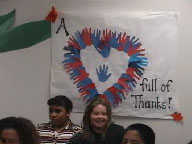
Yesterday and today we had some classes who prepared special expressions of appreciation for our veterans. These were very appreciated. At lunch today they were still talking about the kids yesterday who said, “thank you for your service.” One of the classes yesterday prepared this thank you poster.

This afternoon, Allendale High School and Methacton High School, PA, had students express their appreciation before they asked their question. The high school students were able to share their thanks in their own words vs. reading it off the card with their question. It was very moving for the veterans to hear these expressions of thanks.

Thank you to all the teachers who encourage students to express their appreciation via posters, comments, and thanks to all of our veterans!