Category Archives: Videoconferencing

ASK Author: Belinda the Ballerina

Today we have two classes participating in Polycom’s Special Event ASK program with Amy Young. The students read Amy Young’s book Belinda the Ballerina and prepared for the conference using the ASK process.08-02-29belinda2.jpg

Amy Young started by reading the book to the students.

  • Did you take ballet?
  • Why did you give Belinda such big feet?
  • Why did the judges hate her and the customers loved her?
  • How many times have you been to Paris?
  • Why did you quit being a lawyer?
  • What is your favorite book of the ones you wrote?
  • Did your first job inspire your drawing or writing?
  • Who is your favorite author & why?
  • How do you make a lot of books?

08-02-29belinda.jpgStudents got to see both the draft of the writing as well as the draft of the drawings. This ASK program was unique in that Amy Young is both the author and the illustrator, so students could see the process from both perspectives.

The students also got to hear her new book, Belinda Begins Ballet.

08-02-29belinda3.jpgAmy also had a pair of Belinda’s shoes, which was really cool! The students were very impressed.

This was Amy’s first time doing the ASK program, and she loved it and so did the students! A great experience for everyone!

Read Around the Planet Status

It’s the third day of Read Around the Planet, and so I thought I’d write a bit about how it’s going in our little corner of Michigan. I have 72 RAP connections, but it doesn’t beat Amy Yager’s 125! Aren’t we all crazy!?
This year most of my schools are doing their own test calls and connections.  It’s great to see them become more independent, but I’m having RAP withdrawal. I’m not wearing my outfit this year because I am making so few of the connections and the event runs over 8 days!

On Monday, one of our kindergarten classes was connecting to Alberta. This one was on my bridge, and I watched it for the first few minutes and got a couple of snapshots.

08-02-25rap2.jpg
They had a nice video with pictures and clips from their community. This one was of ice fishing.

08-02-25rap.jpg
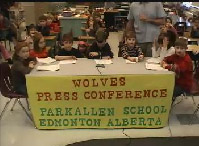
The students did a skit from the wolves perspective on the Three Little Pigs story. Our class had read the book their skit was based on, so that tied in nicely. Notice their sign! We always learn best practices from other classes.

However, after a few minutes, another one of my schools had trouble with their Alberta connection and I ended up spending the next 45 minutes trying to figure it out. Ultimately we decided to reschedule and connect through the Alberta Ed MCU. Thankfully with these connections, usually there’s another way to try it.

I have multipoint Polycom VSX 7000 in my office set up as our “emergency multipoint”. If my schools tested fine with a connection and then can’t make it on the day of the event, they both dial in (it’s set to auto answer), and meet there. This method seems to be working great so far. I’ve had two RAP connections happen that way already.

I’m also spending more time helping with preparation this year. My RUS Grant buildings all have new document cameras, and many of them are using it for the first time with their RAP connections. So I’m reminding them how to use it, listening while they practice, helping them set presets to jump easily from students to document camera and back again. Yesterday a first grade teacher asked me to give the students a little lecture on being quiet in a videoconference.

So, how are your Read Around the Planet connections going?

KC3: Mound Builders

This morning one of my lucky classes is connecting to one of the KC3 programs as part of the competition. Our class is one of the test audiences.

This program is on the Mound Builders and is presented by a school in Oklahoma. Their program included a Moodle site with activities. All of our students got accounts in their Moodle site to participate in the pre activities. I didn’t get to see this, but from what I heard it worked out great.

The videoconference started off with the students in OK asking questions of our students in MI, some of which referred to conversations they’d had ahead of time in Moodle. They talked about the weather, driving to Chicago, sports, snow-mobiling etc.

Dr. Dirt, the lead presenter from OK, drew a name out of a bucket, and threw a t-shirt to Amanda, one of our students. He threw it at the camera, and our teacher threw it to the student. Very funny. The kids really laughed. The t-shirt had the numbers of the student presenters in their basketball team.

After the preliminaries, the students in OK gave a little geography lesson on their state and then moved into the presentation. It included some live presentation from the students, visuals in a PowerPoint, and a taped interview with a local expert on Native Americans. After the video, our students had an opportunity to ask questions, but they didn’t have any.

Next, students learned about excavations and looting that has happened at one of the mounds nearby.  After this, the students divided into three groups already assigned. Within those groups, a person was assigned to be the mapper, the reporter, and the excavator. They had planned to have a jello mold at our site, but it wouldn’t set. So they had to improvise and show the students their jello mold on the document camera. The activity helped students see how excavators and archaeologists map and document everything they find as they carefully excavate.

After this activity, our students talked to the archaeologist who was in the taped interview before and learned about how the jello mold activity is similar to an archaeologist’s actual work. He also talked about what he had learned about the Native Americans who lived in Oklahoma based on his work and research.

After a little blip in the technology, another student shared additional information on how the Spiro people lived along with pictures of artifacts found in one of the mounds. The neat thing about student presentations is the extra humor and interesting questions interspersed throughout the program.

After we got reconnected, the conference went down again due to scheduling on the TN bridge that’s recording this for the KC3 competition. Considering the stresses of the technology, the students in OK did a great job in just keeping on! Our class liked it enough to stick around even though there were difficulties.

At the end, our students asked several questions about the mound builders. Then the OK students asked our kids if they could do a virtual field trip for them and what it could be on. I think it was a stunning question for the kids on our end. But they started to brainstorm some ideas on Michigan. To close, our kids said thank you and all the presenting students got on camera and waved.

This was a neat connection. You could tell the students had built a bit of a relationship ahead of time in Moodle and that definitely made a difference in the interactions, especially at the beginning. I look forward to seeing the results of the KC3 program.

ASK Author: Trapped in Ice

08-02-05trapped.jpgToday we’ve had four sessions of ASK with Canadian author Eric Walters. This program is the fulfillment of about 3 years of trying to find a book and author or specialist for our 6th grade students who study Canada. I am ever grateful to Gillian Patrick of York Region District School Board in Ontario for partnering with us to make this ASK program a success. We split the cost of the author, and they hosted him at one of their schools, and we shared the sessions between our schools. A great partnership!

The students read Eric’s book Trapped in Ice and prepared for the conference using the ASK process. Eric definitely beat the records of all our other authors and specialists, averaging about 65 questions per session. Incredible!

  • In the book, the children were shielded from bad news. When you were growing up, did your parents not tell you something you wanted to know?
  • How would the story be different if they had a metal boat instead of a wooden boat?
  • What is the most challenging part of writing a historical fiction book?
  • Who designed the cover and how did they do it?
  • Why did you decide to write historical stories?
  • Why did you pick Helen to narrate the story?
  • Do you like your book or do you wish you could go back and touch it up?
  • Do you have advice for us when we’re writing our stories in class?
  • How did you choose and develop the characters in the book?
  • Have you ever disagreed with an editor?
  • Do you have any books with characters based on you?
  • Do you use a graphic organizer to write out your books?

Students learned about the writing process and some Canadian history with many laughs and jokes interspersed throughout the program. I look forward to hearing feedback from my schools and I’m sure we’ll be doing program again in the future.

Is Synchronous Distance Learning Worth the Trouble?

Roxanne’s post on the Face Time article in THE Journal reminded me that I wanted to blog about it. The article covers collaborative videoconferences such as Read Around the Planet and Monster Match, as well as the new Collaborations Around the Planet site. Overall it’s a great article, and you should read it.

I, however, wanted to express my angst on how the article ended. It closed with this from an e-learning vendor (emphasis mine):

Real-time communication technologies like videoconferencing, Ericson points out, require synchronous interactions, which rob users of one of the most valuable qualities of web-based networking: the ability to time shift—to interact with others whether or not they’re online with you at the same time. E-mail, blogs, and wikis all allow for time-shifted interactions; online chat rooms and virtual communities such as Second Life require you be there at the same time as those with whom you are communicating.

“One of the big advantages of virtual education and learning,” Ericson says, “is that you can do things on demand, when you want to. We do believe that chatting and videoconferencing have a place. But in our model, it’s not as valuable as allowing students to participate in the community on their own terms, whenever and wherever they are. The idea of forcing a synchronous model, where everyone is on at the same time, well, that’s what a classroom is for.”

!!!!

First of all, you should know that not only am I crazy about VC, I also have taught nine different online classes several times each since 1999. I am taking two online classes right now, and will start teaching two next week. I love the reflection and thoughtfulness in online classes.

But, I don’t think it’s fair to compare synchronous vs. asynchronous distance learning and say one is “more valuable” than another. I also think it is definitely not fair to have a vendor with a vested interest in asynchronous distance learning critique the synchronous medium.

So, here’s the question for you. Is synchronous distance learning like videoconferencing worth the trouble? Is it worth staying up in the evening to connect to places half way around the world?

I can think of a few benefits to real-time – besides the learning that goes on – think of these:

  • motivation
  • enthusiasm
  • engagement levels (think of the posture when kids watch a video vs. participate in an interactive VC)
  • accents & dress differences (can’t see that in a discussion board)
  • body language & face time
  • the feeling of being together and connecting (they are the same as us!)

When I read Roxanne’s list of Read Around the Planet ideas I was encouraged. I’m deep in the challenges of dealing with the RAP leftovers. The ideas reminded me of the kids’ enthusiasm in these events. When you’re tired and stressed with too many videoconferences to suppport, think of the kids. When you get all your matches next week and have a ton of RAP test calls to do, think of the kids. When you’re frustrated with the pain of scheduling, think of the kids. Imagine the faces of the kids in the last VC you did.

What do YOU think? Please comment. Is synchronous distance learning worth the trouble? Why?

It's all in the hat!

This afternoon I called one of my schools that hadn’t signed up yet for RAP and I thought they should have. The media specialist had a teacher staff meeting focusing on tech planned for this evening. She hadn’t asked me to present yet and thought I couldn’t fit it in. Luckily I could.

So on the spur of the moment, I connected for 5 minutes and gave the run down on Read Around the Planet. How it’s fun to tell Texas about snow, and how easy the presentation can be. Of course, I never talk about RAP without my hat on. They wanted to know about the costume, etc.  Lots of giggles and laughs.

Then I asked who wanted to sign up and half the teachers did! Voila! A few more registrations to hurry and get in before the deadline tomorrow.

A visual is a powerful thing! Especially when you can set teachers at ease with a little humor and encouragement!

How did you get YOUR teachers to sign up for RAP this year?

Lit Review: Promoting multicultural understanding and positive self-concept through a distance learning community: cultural connections

Cifuentes, L., & Murphy, K. L. (2000). Promoting multicultural understanding and positive self-concept through a distance learning community: cultural connections. Educational Technology Research and Development, 48(1), 69-83.

Author: Lauren Cifuentes and Karen L. Murphy
Title of article:
Promoting multicultural understanding and positive self-concept through a distance learning community: cultural connections.
Publication year: 2000
Database source: SpringerLink
Name of journal: Educational Technology Research and Development
My Codes: VCProjects

Main Point: Students engaged in year long videoconference collaboration with students of another culture (within the same state) exhibit higher multicultural understanding and greater positive self-concept.

Methods: A qualitative case study method was used to examine two classrooms that connected for nine units over the course of a school year. Data collected included the students’ multimedia portfolios, written reflections of instructors and students involved, and interviews of the students.

Findings:

  • The two teachers were from different cultural backgrounds, and the collaboration created a strong collaborative relationship between them that benefited their instruction.
  • The teachers mentored each other throughout the year.
  • The students grew in their multicultural understanding.
  • The students grew in their cultural sensitivity, as evidenced in their comments at the beginning of the year vs. the end of the year.
  • The students loved the technology and were motivated by it. The interaction with the more well-to-do students inspired the at-risk border students to want to attend college.
  • The students’ misconceptions about each other were dispelled.
  • The students became more confident in their speaking, poise, and behavior on camera. The rest of the students in their schools looked up to them.

Author/Audience: The authors are educational technology professors writing for an educational technology audience.

Thoughts:

Both of Cifuentes and Murphy’s articles feature team teaching as a key component to collaborative projects.

The sustained learning described in Cifuentes’ two articles contrast with the short term one hour experiences in Lee’s study. This makes me think I should follow-through when my teachers are interested in a sustained learning experience. It isn’t too often. Their schedules are so busy. What would it take to establish and facilitate long term collaborations like these? One of my local teachers put out an ad on the listservs for a year-long partner and no one responded. Is it too hard to commit up front without knowing someone? We need to think and experiment in this area more. Two other differences between the activities in the two students are: a much closer age of the participants and the Cifuentes’ activities are more social constructivist.

Many of the activities included self-expression and sharing those expressions. These experiences were clearly key to understanding the other students and becoming friends with them. Don’t you think sometimes we think that that Q&A part of a project such as Read Around the Planet isn’t “curriculum related” when they talk about favorite music, after school activities etc.? But that is important learning too. It helps them realize they are part of a global community and to appreciate and respect differences and similarities.

The student empowerment results are stunning considering the at-risk students studied. It’s so frustrating for me when teachers cancel a program because their students are misbehaving. It seems these types of experiences are just what the students need. It’s motivating and interesting to them. This article defines the results in student positive self-concept and empowerment that can come from a sustained telecommunications project. Seems worth the trouble to me!

One of the references included was a teacher testimonial published online. It’s on the 4Teachers.org site: Bringing cultures closer with technology. If you don’t have access to the databases, this is the next closest thing to get the gist of what was done in this collaboration/study.

Lit Review: Lights, Camera, Action: Videoconferencing in Kindergarten

Yost, N. (2001). Lights, Camera, Action: Videoconferencing in Kindergarten. Paper presented at the Society for Information Technology and Teacher Education International Conference.

Author: Nancy Yost
Title of paper:
Lights, Camera, Action: Videoconferencing in Kindergarten.
Publication year: 2001
Database source: ERIC (at the end of the PDF)
Name of journal: n/a
My Codes: VCProjects

Main Point: Daily desktop videoconferencing between two kindergarten classes resulted in greater weather understanding for students, as well as greater understanding on time, distance, and understanding other children.

Method: A description of a project, not a research study.

Desktop videoconferencing was used to connect two kindergarten classes, one in Pennsylvania, and one in Illinois. The classes reported local weather to each other daily for a six week period. They would share the weather and then visit for a while. Sometimes they asked questions of the other class for their daily graph. Each daily VC was 10-20 minutes long, in a three hour half day kindergarten.

Other Internet activities were: the “meteorologist” classroom job included checking out a weather cam of personal choice, visiting a local TV station to learn about weather reporting, and practiced weather reporting within the classroom. I linked the site they used, which still exists, but most of the links are broken.

Findings:
The author felt that the learning that came from the questions and understanding the other children was worth the time committed to the daily videoconference. The project focusing on weather grew to be an interdisciplinary project in several curriculum areas.

It’s interesting that the last two studies I’ve read are from university laboratory schools. I wonder if there is a difference between students in university lab schools and “regular kids”.

The planning started with a common long term curriculum within the classroom: weather reporting. It’s important to start with existing curriculum.

Author/Audience: The author was from a university, and was presenting this paper to an educational technology audience. The lessons were used as a demonstration for preservice teachers as well.

Relevance: This is K-12 project that fits my definition of curriculum videoconferencing. Right on target.

Lit Review: Distance learning among Mexican and Texan children.

Cifuentes, L., & Murphy, K. (1999). Distance learning among Mexican and Texan children. Educational Technology Research and Development, 47(4), 94-102.

Authors: Lauren Cifuentes and Karen L. Murphy
Title of article:
Distance learning among Mexican and Texan children
Publication year: 1999
Database source: Wilson Select Plus. Also available through SpringerLink.
Name of journal: Educational Technology Research and Development
My Codes: VCProjects

Main Point: While students may not understand a distant culture or distant students, with well designed collaborative videoconference activities over a sustained amount of time, shared understanding can be gained.

Background:
The authors reference Moffett (1994) to emphasize that students need to develop relationships with people from diverse backgrounds in order to become more tolerant and respectful citizens. They reference Cummins & Sayers (1995) to suggest that collaborative learning has the potential to transform students’ perspective “from parochial to global.” A peek at the description of Cummins & Sayers’ book on Amazon.com sounds very intriguing. I wonder if their vision from 1995 holds up in 2007 with the advent of H.323 videoconferencing and Web 2.0.

Methods:
This was a qualitative study that used content analysis and observations.

Two classes in Mexico City connected with two classes in College Station, Texas over a whole school year. Now that’s an extended collaborative project! Interestingly, the “activities were designed in response to Postman’s (1995) narratives that learners should share in order to achieve the diesred ends of education” including “stewardship of Earth, religion, democracy, diversity, and language.”PDF p. 2. The classes met mostly with videoconferencing, but occasionally via email. The student collaborative experiences were designed for “social construction of meaning (PDF p. 2).

First the two classes received two hour writing workshops, and students learned about poetry written about other places. Then the students wrote an “I am” poem describing what it might be like to live in the other country (Mexican students about the US; US students about Mexico).

Data collected included the poems, the lesson plans, and researcher observations and questioning during the lessons. Content analysis was conducted on the students’ poems.

Findings:
PDF p. 6 Research question 1: “What impressions did the students have of each other?”

The Mexican students had moderate-to-high levels of knowledge about the United States, and their images were mostly positive. The Texan students were “unable to paint a vivid picture of Mexico”. Only a little over half of of the poems were completely positive. The Texan students used only four of the six likely sources of information that the Mexican students used. Most of the Mexican students “had enough experience with U.S. culture to accurately portray it in poetry”, but the Texan students had little firsthand knowledge, so they wrote “about their own culture, created an imaginary place, or referred to stereotypes.” p. 6. The authors suggest that this discrepancy indicates a need for teacher Texan children about their neighbors.

p. 6 Research question 2: “What activities brought children of Mexican and Texan cultures together successfully to learn with, about, and from each other?”

The students wrote the poem, as well as a story about the day in the life of a fourth grader in the other country so that they could see how much they had to learn throughout the year. They also created documents about themselves and exchanged these via a messenger who traveled back and forth for unrelated business.

The book I Felt Like I Was From Another Planet was used to think of ideas. They compared table manners across cultures.

They met two times to meet each other, a third time to learn about the interpretive nature of history focused on the Alamo, a fourth time to read diaries, reenactments and share comparative essays about the Alamo, a fifth to share folk tales and folk songs, and finally to share murals of their hometowns. Writing activities were included for each of these videoconferences. Each videoconference also had “a flood of questioning” as they learned how they were similar and different. This study is an excellent example of a collaborative project design and the quality learning experiences that accompanied each videoconference.

p. 8. The differences among the students may be in part related to their socio-economic status. The Mexican students attended an exclusive private school, whereas the Texan students attended public school. The Mexican students had many opportunities for travel, while the Texas students had not.

Author/Audience: At the time of writing, the authors were both college instructors of educational technology. The article is written for those interested in distance education and educational technology.

Questions/Thoughts:

p. 2. The authors used Laughon’s (1998) four phases of online telecommunications projects: planning, advertising & registration, coordinating/moderating, and evaluation. I do think that we need to learn the lessons from Internet and email based projects as we develop and implement our videoconferencing projects.
Full reference: Laughon, S. (1998). Designing effective telecommunications projects. In Z. L. Berge & M. P. Collins (Eds.), Wired together: The online classroom in K-12, Vol. I: Perspectives and instructional design, (pp. 175-183). Cresskill, NJ: Hampton. This may warrant further instruction. Is anyone publishing these kinds of books now? Or did internet projects go away with the onset of Web 2.0?

PDF p. 4. “All videoconferences involved preconferencing, conferencing, and post conferencing activities for the students.” See a pattern emerging? Preparation is key! Even though the study doesn’t focus on that, several of these so far include a strong preparation component to the videoconference.

PDF p. 4 “Understanding the strong Mexican accent via videoconference technology required great concentration on the part of the Texan fourth-graders.” Have you noticed this with international VCs? Sometimes it’s very hard for the students to understand each other. We need to remember that when planning activities.

p. 5 The classes learned about their ancestries to find how many of them had parents born in other countries. They shared a self-collage in the first videoconference where they met each other. They said, “They are the same as us!” Sound familiar?

The authors created a model called “Cultural Connections.” It may be worth spending more time on this model and integrating it into my work.

The authors really didn’t focus on the effects of the technology or even describe what type of videoconferencing was used. The focus was on what they learned and how their perceptions changed throughout the year. Nevertheless, the experiences documented are a great model for videoconference collaborative projects, especially the international ones.