
Lit Review: World's youth connect through Global Nomads Group: An interview with GNG's David Macquart

Lit Review: This is a post in a series focusing on the research studies on videoconferencing.

Morrison, J., & Macquart, D. (2006). World’s youth connect through Global Nomads Group: An interview with GNG’s David Macquart. Innovate, 2(4).

Author: Morrison, J and Macquart, D
Title of article: World’s youth connect through Global Nomads Group: An interview with GNG’s David Macquart
Publication year: 2006
Database source: Innovate
Name of journal: Innovate
My Codes: VCContentProviders

Main Point: This article is an interview between Innovate’s editor and one of Global Nomads Group (GNG)’s founders. The article shares the history of GNG, it’s impact, features some of the programs, and shares the challenges.

Theoretical Framework/References: Not applicable, not a research study. The one reference is used to show that Americans lack in cultural understanding.

Methods, Sample, Variables/Case:  Not applicable, not a research study.

Findings: Not applicable, not a research study.

Author/Audience: The audience is the Innovate readership.

Questions/Thoughts/Implications:
The article shows how the vision of a few to meet the needs of students can expand to a respected non-profit organization.

GNG has offered some incredible international programs, but they are often only offered that one year. This makes it hard to “institutionalize” the learning. GNG wishes to offer more programs more consistently, but is hampered by funding issues. Nevertheless, many of our students have benefited from the incredible learning experiences offered by GNG.

“Most of the issues addressed in our programs continue to challenge governments and international institutions….” GNG certainly doesn’t skirt around tough issues. They have the facilitation expertise to deal with tough issues too. I’ve experienced their facilitation skills both in training and with students. 

This article provides anecdotal evidence of the power of videoconferencing to bring experiences and interactions to students that would be impossible otherwise.

Lit Review: A Content Analysis of Videoconference Integration Plans

Lit Review: This is a post in a series focusing on the research studies on videoconferencing.

Newman, D. L., Du, Y., Bose, M., & Bidjerano, T. (2006). A Content Analysis of Videoconference Integration Plans. Paper presented at the Society for Information Technology and Teacher Education International Conference, Orlando, FL.

Authors: Newman, Dianna L.; Du, Ying; Bose, Mohua; Bidjerano, Temi
Title of paper: A Content Analysis of Videoconference Integration Plans
Publication year: 2006
Database source: EdITLib
Name of journal: N/A
My Codes: VCContentProviders

Main Point: This study analyzed 46 lesson plans by teachers developed around content providers’ programs. These were part of the ProjectView grant that ended in 2005. The integration lesson plans are online here.

Theoretical Framework/References:
Several references are used to make the case that museusm already have educational content for schools, videoconferencing provides access to those resources, students participating in a videoconference engage in higher order thinking skills, and videoconferences enrich curriculum with an “active learning environment” and by “facilitating inquiry-based learning”. (p. 2). Two noteworthy references I hadn’t found already were Newman et. al 2004 and Silverman & Silverman 1999.

Methods, Sample, Variables/Case:
Content analysis was conducted on 46 lesson plans from New York State. The lesson plans were created by 63 teachers and educational consultants from 25 school districts. The lessons featured 26 content providers. A coding sheet was used to analyze the lessons. It’s included in the paper and has checkboxes for the various types of learning experiences and resources included in the lessons.

Findings:
The majority of the lesson emphasis (time) was on pre-conference preparation.

The most popular methods of instruction were the structured discussion/socratic method (65%). Next were lecture/direct instruction (46%), teacher demonstration (44%), and constructivism (43%). p. 4

Traditional modes of learning were used more leading up to the conference, and the student-centered constructive learning was used more after the videoconference.

The lower levels of Bloom’s taxonomy were used more in the pre-conference activities, and the higher levels of Bloom’s taxonomy were used more in the post-conference activities.

Rubrics, projects, and worksheets were the most popular assessment techniques used by the teachers.

Author/Audience: The authors are connected with the NYIT EEZ, which is a strong content provider support program in New York. The audience was the conference attendees, so people interested in educational technology and teacher education.

Questions/Thoughts/Implications:

Quotes: “The videoconference session may be considered as a catalyst for promoting higher levels of thinking during post videoconference sessions.” p. 5.

The videoconferences were used to “extend” and “enrich” the study. p. 5 But before you protest about those words, check this: students would be “exposed to richer alternative sources of information, real artifacts and animals, meet external experts, and get their questions answered.” And videoconferencing leads to “a more dynamic and interactive form of learning” p. 5.

This article emphasizes the importance of preparation for videoconferences, as well as essential component of wrap-around lessons to accompany videoconferences. Using a videoconference as a stand-alone “fun” activity is not appropriate! I really like the Project VIEW focus on teachers creating lessons to support their experiences with content providers. 

Note to self: This is a great article for the week on preparing students in my online class, Planning Interactive Curriculum Connections.

What is a Question?

This afternoon one of my classes did the Sea Me Read program with Mote Marine. I love this program – high energy and informative. I’ve blogged it before, so you can check that out for a full description with pictures.

08-02-28seameread.jpgWhat I noticed this time was the intentional instruction before the Q&A time. How many young students have you seen flounder when offered a chance to ask questions?! They don’t know the difference between a question and a statement. So they try to tell the presenter a story or something that they know, often off topic.

Mote Marine put this slide up before the Q&A time and accompanied it with a cheerful reminder of how to ask questions. Very cool. Something to remember for future young student programs!

Continuing the Asynch. vs. Synch. Conversation

If you’re not already reading Roxanne’s blog, read her post on “Does a screwdriver make a good hammer?” Make sure you click the link to Wes Fryer’s post that she references. There’s a great graphic on there comparing web 2.0 tools for interactivity and sycnchronous vs. asynchronous. I’m too brain-fried to add any other words of wisdom, but the idea of balance is sinking into my brain – transmission and construction both are necessary to learning. Think about it!

Read Around the Planet Status

It’s the third day of Read Around the Planet, and so I thought I’d write a bit about how it’s going in our little corner of Michigan. I have 72 RAP connections, but it doesn’t beat Amy Yager’s 125! Aren’t we all crazy!?
This year most of my schools are doing their own test calls and connections.  It’s great to see them become more independent, but I’m having RAP withdrawal. I’m not wearing my outfit this year because I am making so few of the connections and the event runs over 8 days!

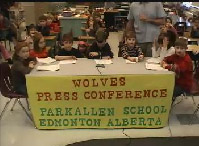
On Monday, one of our kindergarten classes was connecting to Alberta. This one was on my bridge, and I watched it for the first few minutes and got a couple of snapshots.

08-02-25rap2.jpg
They had a nice video with pictures and clips from their community. This one was of ice fishing.

08-02-25rap.jpg
The students did a skit from the wolves perspective on the Three Little Pigs story. Our class had read the book their skit was based on, so that tied in nicely. Notice their sign! We always learn best practices from other classes.

However, after a few minutes, another one of my schools had trouble with their Alberta connection and I ended up spending the next 45 minutes trying to figure it out. Ultimately we decided to reschedule and connect through the Alberta Ed MCU. Thankfully with these connections, usually there’s another way to try it.

I have multipoint Polycom VSX 7000 in my office set up as our “emergency multipoint”. If my schools tested fine with a connection and then can’t make it on the day of the event, they both dial in (it’s set to auto answer), and meet there. This method seems to be working great so far. I’ve had two RAP connections happen that way already.

I’m also spending more time helping with preparation this year. My RUS Grant buildings all have new document cameras, and many of them are using it for the first time with their RAP connections. So I’m reminding them how to use it, listening while they practice, helping them set presets to jump easily from students to document camera and back again. Yesterday a first grade teacher asked me to give the students a little lecture on being quiet in a videoconference.

So, how are your Read Around the Planet connections going?

Lit Review: Is it Live or is it Memorex? Students' Synchronous and Asynchronous Communication with Scientists

Lit Review: This is a post in a series focusing on the research studies on videoconferencing.

Kubasko, D., Jones, M. G., Tretter, T., & Andre, T. (2007). Is it Live or is it Memorex? Students’ Synchronous and Asynchronous Communication with Scientists. International Journal of Science Education, 30(4), 495 – 514.

Authors: Kubasko, Dennis; Jones, M. Gail; Tretter, Thomas; Andre, Thomas
Title of article:
Is it Live or is it Memorex? Students’ Synchronous and Asynchronous Communication with Scientists
Publication year: 2007
Database source: InformaWorld
Name of journal: International Journal of Science Education
My Codes:
VCContentProviders

Main Point: The study compared students’ interaction with scientists via email and via real-time conferencing. The interactions were accompanied by real-time access to live data to remotely control an atomic force microscope (for the realtime group) and recorded experiments with the microscope (for the via email group). Both groups gained in their knowledge of viruses. Students in the asynchronous group asked more inquiry and interpretation questions than the synchronous group. All of the students were one-on-one with the scientist and NetMeeting was the synchronous method.

Theoretical Framework/References: Theoretical frameworks referenced include inquiry-based learning and hands-on science learning; as well as Vygotsky’s social constructivism. Several references are used to compare synchronous and asynchronous online learning.

Methods: The students participated in the instruction – learning about nanotechnology, then working through stations to conduct experiments and interview the scientists (twice), and finally writing a newspaper article about what they learned.

Data was collected from the students interactions. The live interactions were video taped and transcribed. The asynchronous email communications were captured for analysis. The students’ interactions with the experiment (live or replayed) were also captured for analysis.

Knowledge assessments were used before and after the activity and the newspaper articles were analyzed for content.

Sample: Eighty five biology students from four high school science classes in one school. The classes were randomly assigned to synchronous and asynchronous groups.

Findings:

  • Both groups asked the same number of questions.
  • The content of the asynchronous questions were most frequently about inquiry/interpretation.
  • The majority of the synchronous questions were informal and about the scientist, personally.
  • In both groups there was a significant shift from two-dimensional to three-dimensional understandings of the viruses.
  • Both groups understood the actual shape of the viruses better.
  • The asynchronous students wrote much longer articles for the newspaper than the synchronous group.
  • The asynchronous group made significantly more statements about what they learned or knew in their articles.

Questions/Thoughts/Implications:
The researchers’ found these results encouraging, since providing this access to students is easier and cheaper using the replayed experiments and email communication vs. live experiments and live interaction with the scientists.

The researchers called the synchronous group students’ fascination with the live interaction the “actor phenomenon”. The scientist in some cases was more interesting to the students than the experiment. Is this a good thing or a bad thing? Depends on your learning goals!

The researchers believe “future research needed to document how students can benefit most from communicating with scientists. What aspects of communication with scientists impact knowledge of science versus other variables such as attitudes, knowledge of science processes, knowledge of science careers, or images of scientists?” p. 17-18. Cross reference with McCombs’ evaluation and Shaklee’s study.

It’s really interesting how the email was more formal and thought out. There’s certainly something to be said for thinking about the questions ahead of time. See McCombs’ study.  In this study, it doesn’t appear that the live interaction students had a chance to think carefully about their questions. I wonder how this would compare, say, to the live interaction around a taped program like COSI Columbus’ In Depth Autopsy program. This article was especially interesting since my rant about asynchronous vendors knocking synchronous technologies. Asynchronous can be more thoughtful, yet synchronous has an energy and excitement to it. Which is better? What about the visuals? In this study, the visuals were the same – both groups could see the experiments. Certainly something to keep thinking about!

Lit Review: The Virtual Scientist: Connecting University Scientists to the K-12 Classroom through Videoconferencing

Lit Review: This is a post in a series focusing on the research studies on videoconferencing.

McCombs, G. B., Ufnar, J. A., & Shepherd, V. L. (2007). The Virtual Scientist: Connecting University Scientists to the K-12 Classroom through Videoconferencing. Advances in Physiology Education, 31(1), 62-66.

Author: McCombs, Glenn B.; Ufnar, Jennifer A.; Shepherd, Virginia L.
Title of article:
The Virtual Scientist: Connecting University Scientists to the K-12 Classroom through Videoconferencing.
Publication year: 2007
Database source: Originally found in ERIC, but the full text is available through the journal.
Name of journal: Advances in Physiology Education
My Codes: VCContentProviders

Main Point: This article is essentially an evaluation of Vanderbilt University’s CSO videoconference programs. It suggests that videoconferencing can bridge the gap between formal textbook learning and real world science. It shows that many students do not get to talk to real scientists at school and videoconferencing allows for increased interaction with scientists. Details reports are given of the evaluations that students, teachers, and scientists complete after the experience.

Theoretical Framework/References: No theoretical framework was used, but the article references Amirian’s lit review, Cavenaugh’s meta-analysis, Greenberg’s lit review, Heath’s lit review, Scott Merrick’s Innovate article, and some articles on the “no significant difference” phenomenon. Sorry, no links at the moment, but I’ll be adding blog notes on these articles in the future.

Methods, Sample, Variables/Case: The article describes the program in detail. It also includes survey data on future participation and scientist accessibility, responses regarding technical issues, and responses regarding the impact of videoconferencing. Interestingly, this is the first article I’ve found that surveyed the experts who were presenting the videoconference (in a content provider situation).

Findings: Overall the experts, students and teachers were satisfied with the experience and would participate again.
Author/Audience: The audience is readers of the journal Advances in Physiology Education, so basically scientific educators, probably more at the university level.

Questions/Thoughts:
In tiny print at the bottom of the article, it says: “The costs of publication of this article were defrayed in part by the payment
of page charges. The article must therefore be hereby marked “advertisement” in accordance with 18 U.S.C. Section 1734 solely to indicate this fact.” Very interesting.

p. 65. The most successful VCs are the ones where the teachers have prepared the students and the students have prepared questions ahead of time to ask.

There’s a lot of detail on how they organize and run the program that would be interesting to other content providers getting started.

Point-to-Point MysteryQuests

08-02-21mq.jpgThis week I’ve been facilitating three Point-to-Point MysteryQuests for Reed Middle School in Bridgman, MI. They connected to MO, NJ, and CA. It’s our first time running MysteryQuests in just an hour with just one other school. The time frame better fits the traditional middle school schedule and makes it easier for the teachers to schedule and participate. We did one each day so that they weren’t scheduled back to back.

The schedule is generally as follows – with some flexibility depending on how everything works out:

  • 5 min. Introductions & background info about each of the schools
  • 15 min. Presentations from both schools
  • 15 min. Research with NO computers
  • 5 min. Research with computers
  • 5 min. Clarifying questions
  • 5 min. Reconsider answers and more research (computers allowed)
  • 10 min. Sharing guesses, correct answers, and some time to ask each other questions.

The teacher and I discussed the computers issue and decided to not allow computers during the first research portion. The hard thing about a decision like this is the varied difficulty level presented by the other classes. One of the class presentations was so hard that we didn’t get it at all. The other one we were able to get even after losing 20 minutes to technical difficulties. It seems to be an issue to play by ear. In the session with the hard presentation, we allowed the students to use computers sooner.

If you’re familiar with the MysteryQuest format, you’ll notice that one difference here is the amount of research time. In a traditional multipoint MysteryQuest format, students have 30-40 minutes to research. Of course in that format they are research 4-5 other presentations. In this case, the whole class is researching the one presentation. In theory it should go faster. But we did find this week that each time when the 20 minutes were up the classes wanted more time.

The classes seemed to be mostly involved as usual. I did notice some “behavior” in front of the camera towards the end of the research times. With just one presentation to research, it’s harder to get all the students involved in the research. Easier to lose some who are prone to get distracted anyways. However, it seems to me that the lack of scheduling headaches seems to outweigh this disadvantage to the shortened format.

In the connections where we didn’t have technical difficulties, we were able to spend more time letting the students ask each other questions.

My sense is also that if a teacher does this a couple times, they’d be able to do a point to point MysteryQuest without a facilitator. I would like to get to that point so that we can increase the number of these sessions. There’s only so many sessions a person can facilitate!

I look forward to additional feedback from my teacher. We’re doing another point-to-point one in March with a different teacher, so we’ll see how that one goes too. Overall though, I’m pleased with this adaptation of the program to make it easier for our middle school classes to participate.

Creative News Shows

Running another MysteryQuest Western Hemisphere today. One of my favorite formats for presentations is news shows. You can see some examples in the MysteryQuest video.

Today’s most entertaining presentation was from O.W. Best Middle School in Dearborn, MI. They had a news show with all kinds of interesting facts and lines while giving their clues.

One funny clue started with, “From the Institute of Boring Information, the nearest body of water is…”

The one that really caught my attention was, “Police are tracking a tourist named Ms. Janine Lim who is suspected of hijacking a boat.” That really perked up my ears. Thankfully, later in the broadcast, the student news show reported, “All charges have been dropped for Janine Lim. It was discovered that she actually owns the boat.”

Very creative, O.W.Best! You made me laugh after a morning of too many technical problems! 🙂 I wish I really did own that boat. See you in the next MysteryQuest in March!

There are still a couple openings in MysteryQuest World in March. Let me know if you want in but are struggling with funding. Also, I’m beginning to get dates together for MysteryQuest USA in April. In a week or so those should be ready for registration as well.

Lit Review: Videoconferencing exposes students to new worlds

Lit Review: This is a post in a series focusing on the research studies on videoconferencing.

WMHO. (2002). Videoconferencing exposes students to new worlds. T.H.E. (Technological Horizons in Education) Journal, 29(8).

Author: Ward Melville Heritage Organization (or THE Journal staff? it isn’t clear)
Title of article:
Videoconferencing exposes students to new worlds.
Publication year: 2002
Database source: T.H.E. Journal
Name of journal: T.H.E. Journal
My Codes:
VCContentProviders

Main Point: Videoconferencing allows a non-profit science organization to protect the salt marsh wetlands and still educate students about it. It allows WHMO to reach more students than would be possible with onsite visits.

Limitations:
This isn’t a research article and does not include a theoretical framework or any research data or references to other work. Well, page 3 says,”research has shown” the benefits of VC, but no references are provided. A few sentences describe teachers’ feedback from the sessions.

Notes:
The article describes how WMHO transformed an on-site field trip to a 45-60 minute engaging interactive curriculum-based program for videoconferencing. The program includes a learning kit with lesson plans, worksheets, activities, and a CD-ROM with additional resources. The article describes the visuals shown, including some innovative cameras that allow for visuals right from the water’s edge.

The article describes the reach of the programs – locally in the tri-state area and to several other states as well and mentions 12,000 students served.

Relevance:
While not a research article, this article does describe one aspect of curriculum videoconferencing – the content provider experience.