Which collaboration site should I use?

In the last few weeks I’ve facilitated several collaborative VC projects, worked on a few, and taught a few workshops on videoconferencing projects. It’s made me think about projects and what it takes to make them happen. I’ve been thinking about how to find collaborative partners, and how those relationships evolve. Here are a few partner sites, tools, and strategies I use.

Alberta, Canada
When I want to collaborate with someone in Alberta, I use the VCAlberta social network, or email Alberta friends I’ve collected from Read Around the Planet, my online classes PICC & K2K, and the Alberta summer conferences such as Elevate 2008. I’m also learning about the possibilities with the 2Learn.ca site.

Ontario, Canada
When I want to collaborate with someone in Ontario, I use the Interactive Classroom site, or email Ontario VC friends I’ve collected from various experiences.

England, Scotland, Wales in the United Kingdom
UK connection are great collaborations. The time change is manageable for US EST, and the cultural difference is enough to make the connection really fun as well as curriculum related. There are three sites I use for UK partners: Collaborations Around the Planet, Global Leap, and Janet Collaborate.

Other international partners
For connecting to other countries, I’ve found that the Megaconference and Megaconference Jr. listservs are the best source for a potential international parter. You get on the Megaconference listserv by participating in the event.

Internet2 / International / University
If you want an Internet2 partner, international partners, or university level partners, another collaboration site to check out is the Internet2 K20 Initiative Muse site just released this fall.

Needing a partner fast
When I need a partner really quickly for a project within a few weeks, I send a note to the K12 IVC listserv. Usually I can fill a project within a couple hours. Partners responding are almost always US schools.

Needing lots of partners
For projects that I need lots of partners (like MysteryQuest), I post my request on several sites: Collaboration Collage, K12 IVC listserv, Megaconference Jr, and sometimes on the CILC Collaboration Center if I can wait for the announcement to go out on the next Monday.

Sustained Collaborations
There are also scenarios with sustained collaborations where I use “my collection” of videoconferencing friends. I have a folder in my email for all the states, provinces and countries where I know someone with VC. I also have a few good buddies like Arnie and Roxanne and others! who can help me get partners in a pinch. Some of those partnerships, especially those with Arnie & Roxanne, mean long term sustained shared collaborative projects and team facilitated events. Now that CAPspace is up and running, I’m starting to turn there when I need a phone number or email for a VC friend.

What are the strategies and tools that you use for finding collaborative partners?

International Eco-Conversations: Carbon Emissions

Last week we had five sessions over two days of our Eco-Conversations project. Dowagiac Middle School connected to five different schools to discuss carbon emissions.  Here are some notes I wrote during the sessions:

The presentation from Westcliff High School for Girls included a play on “The Weakest Link”. Five students were interviewed about how they got to school. After their carbon footprints were revealed, the student with the highest carbon footprint was pronounced “the weakest link. Goodbye!” Their students also interviewed our students as part of a school energy use survey.

The Simon Langton Grammar School for Boys is one of the only schools in their area to receive a “green flag” status for schools in their area. We learned a lot about what they are doing for the environment in their school and community. This connection we had trouble with the audio. At the end, they couldn’t hear us, but we could hear them. Some students ran quickly to get a whiteboard and they improvised. It still worked out very well. Even in the Q&A section, students were focused on the environment issues. They asked questions such as, Do you have ethanol for your cars? How far do you drive to school? Do you have all big cars in America or is that just a British myth?

Next we connected to Rosslyn Jr. High, in Edmonton Alberta. Students asked questions like, What is your local government doing to reduce carbon emissions? And, what is the cost of gas in your area?

St. Peters Church of England School. This group is working on putting a recycling plan in place in the school. As it happens, they have a group called the Global Action Plan coming to their school for a waste audit the day of the conference. Their presentation included the work they are doing on waste products and also about the waste audit. There are about 10 students in the EcoGroup school club.

When talking to the coordinators and technicians, we learned that there are over 200 schools in the UK who want to do projects like this. I think there is a big untapped market for collaborative projects in the UK. We just need to figure out how to find each other. I believe that sites like Collaborations Around the Planet, Global Leap, and Janet Collaborate are important tools for finding collaborative partners in the UK. The trick is, if at all possible, figure out the time zone difference for your desired connection ahead of time so you can ask for reasonable timed connections of your potential partners. When we emailed for partners, I listed both times, EST & UK.

One issue with this project was the preparation for the presentations. I did hear from concern about the amount of preparation work. I hear this a lot from our middle schools, and wish we could design more projects that are easier to implement for tight curriculum schedules for middle and high school students. However I did receive this reaction from the lead teacher for the project:

My students absolutely LOVED IT. You know they really liked it when they are telling other teachers and students about it!!! Talking to another country is by far the best VC out there!! When you have students like those here in Dowagiac who have maybe been as far away as Detroit or Chicago (many not that far) they are fascinated with the accents, language usage…….very cool, I would talk to another country any time it was available!

Finally, thanks to Google Alerts, I ran across this great write-up from the  Dowagiac Daily News.

A great experience for one of our RUS grant schools, showing the power of videoconferencing in rural schools.

Interviewing World War II Veterans

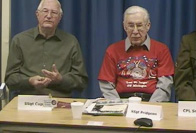
Today we have another session with our World War II veteransWorld War II Veterans, as part of our Lest We Forget series. Today’s session was extra poignant, because we lost one of our usual panelists last week. These moments with our World War II veterans are precious and treasured by teachers and students alike.

After reading Ashton’s blog and looking at her pictures, we decided to include the name tags as she did. This worked out fairly well and our veterans appreciated it. I think I still need a bigger font! Maybe folding lengthwise with landscape will work better than a traditional 2 fold name tent.

07-12-07ww2-b.jpgThis was also our first program with our new blue curtain/backdrop. It’s mobile so we can move it to whichever distance learning room we want to use it in. I also used presets to zoom in on specific veterans instead of using just the shot of the four panel members. I think this presented a better picture for the participating classes.

Here is a sampling of the questions from the students today.

  • D07-12-07ww2-c.jpguring the war, did you know about the Holocaust?
  • What was victory day like?
  • How would you compare your equipment to that of soldiers of other nations?
  • If you have seen any movies on World War II, do you think they did justice to what you experienced?
  • What did you do for fun during your time in the military?
  • Do you ever keep in touch with anyone you were in the war with?
  • What personal items and artifacts did you have with you?
  • Have you ever returned to the site where you served or fought?
  • If you knew someone going into a war, what advice would you give them?
  • How did your families feel about you going into the war?
  • Did you have any plans before the war that had to be changed?

As always, this was a great experience for everyone involved. I recorded it and hope to be able to edit it so that we can share online without the students’ faces. A couple of the schools can’t get parent permission, so we can’t show the whole program. The veterans were very glad that I was recording. After we finished the last session today, I said, “See you in March.” And they responded, “If we’re still alive!” It’s sobering, but they are very appreciative of the opportunity to record and share their stories with future generations.

Geography I Spy

Today we have the last session in a series of Geography I Spy programs. We copied this idea from Paul Hieronymous. Paul even VCed with us to help us get this program going.

Kevin starts the session zooming in on our location and the school location to get the students familiar with Google Earth. For each location the students guess, he zooms in and gives some background information and clues to help the students guess. Each zoom out is accompanied by even more clues.

Today’s session is with a 6th grade class. They are studying Western Hemisphere geography this year. The teachers’ submitted the locations ahead of time. We tried to get clues from the teachers ahead of time as well, but that didn’t work so well. Some of the locations for this class were:

  • Ottawa, Canada
  • Georgetown, Guyana
  • Havana, Cuba

We ran into a few issues with some of the schools’ whose bandwidth is pretty jammed. But if we skipped the zooming and just showed a still screen it worked fairly well.

We decided that 2nd grade is too young for this activity. The 2nd grade class that participated didn’t guess any of them. But the teacher still thought it was a useful exercise. “I think the kids really enjoyed it. It gave them a way to apply what we are learning in social studies to the “real world” so to speak. We study cities, urban areas, etc. and this will help the kids remember those areas better. ”

Each session was 30 minutes long. While we addressed geography skills and exposed the teachers to videoconferencing, the session was also professional development. Several of the teachers mentioned that they learned how to use Google Earth with their students and plan to do that in the future.

Singing with Rudolph

07-12-05rudolph.jpgWe’re lucky enough to have four classes from Mars Elementary included in Region 12’s Holiday Extravaganza, Singing with Rudolph program yesterday and today. They are all kindergarten classes and they loved it!

Rudolph starts out asking the kids to show their antlers and to laugh like a reindeer. This breaks the VC ice and gets the kids moving & interacting. Rudolph sings songs like Santa Claus is Coming to Town, and Jingle Bells. Rudolph also asks the students some questions such as: What do elves learn in school? The elf-abet! This is a short but excellent example of getting the students to interact from the very beginning of the session. They answer questions, do motions, sing, and participate the whole way through!

I grabbed a picture of “Rudolph” from Roxanne’s blog. This way you can see how it’s done. “Rudolph” also has his own band – check it out!

This is a fun and easy program that introduces kids and teachers to videoconferencing in a low-key format. It hooks them on VC to try other programs. Thank you to Shane & Roxanne for sharing this program with us!

Indy Zoo: "The Mitten"

07-12-05indyzoo.jpgThis afternoon Eagle Lake Elementary is connected to the Indianapolis Zoo for “The Mitten” program. We had a few little glitches with this program. The zoo had a fire, and some of the animals for this program were injured, so this program has been adapted to the book The Three Snow Bears by Jan Brett instead. We’re glad that we can still do the program.

In addition, this morning Eagle Lake had a 2 hour delay due to the snow. Thankfully the Indy Zoo could squeeze us into the 1:00 slot so we could still participate.

After introductions, student brainstorm various clothing items to pack when traveling to the Arctic. Then they brainstormed what animals they might see on a trip into the north. The presenter reads the book, The Three Snow Bears, and asks the questions predicting and comprehension questions throughout the story.

After the story, students discuss the similarities and differences between this story and Goldilocks and the Three Bears. They learn facts about polar bears, see a polar bear skull, and learn about the polar bears who live at the Indy Zoo. Students also get to ask a few questions at the end of the program. Students really enjoyed the interaction.

Lumberjack Life

07-12-04lumberjack.jpgToday Moccasin Elementary is connecting to Northern Michigan University for their Lumberjack Life program. The program started with a lumberjack song for the students to listen to. During the program the students saw many pictures showing how the lumberjacks worked, what they ate, what machines they used, and more. Students learned about several different type of trees that were logged and what they were used for. The presenter also tells some delightful stories of real northern Michigan lumberjacks.

07-12-04lumberjack2.jpgThe program consists of a mostly telling and pictures, but is jam packed with details about how the lumberjacks lived and worked. Students are encouraged to answer and ask questions throughout the program. The program is like talking to a real live lumberjack!

How to Lie with Statistics

Huff, D. & Geis, I. (1954). How to lie with statistics. New York: Norton.

Time for another book review! I’m almost done Applied Statistics for Education and Psychology I that I’ve been taking this fall. One more week, one more unit, one final paper, then I’m done!

My dad gave me the musty old bright orange book called How to lie with statistics to supplement my reading for the course.  Sounds kind of unethical, doesn’t it? But this is a really funny book that puts the principles and concepts in Stats into real-life situations where you can see the consequences of getting it wrong! It’s an easy read, written in layman’s language. Certainly very old, and you’ll notice the numbers on salaries etc. in the examples are amusingly low. Still, it’s a great way to “take a break” from stats while still working on drilling the concepts into your brain.

The book addresses sampling issues, the different types of averages and how they can be used incorrectly (remember mean, mode, and median?), the acceptable way to create charts (makes you examine carefully charts you see in the news), probable errors and standard errors, and more.

And of course, what has been drilled into my head this past fall: causation is NOT correlation! Ah, bummer. I thought I’d be able to do some research on factors that influence how much my districts use videoconferencing, but even if I find a significant correlation, it still doesn’t necessarily mean those factors caused their high use of VC. Stats is a good reality check for what you can and can’t say with authority.

So, if you’re taking a stats class and it’s driving you crazy, I recommend this little gem. Dig it out from the recesses of your nearest library and enjoy a musty smell and an amusing read. All the while you’ll be learning stats a little better!

Oh, look! Amazon.com is selling a 1993 edition. I’m sure it won’t have quite the same aura of a 1954 edition. But probably still a great read.

Interviewing State Representative John Proos

This morning we have several local 5th grade classes connected to John Proos, one of our local state representatives. The teachers and students have prepared questions ahead of time, particularly to bring out answers related to what they are studying. We were able to get 25 questions into the hour session. Here is a sampli07-12-03proos2.jpgng of the questions.

  • What is the hardest part of your job?
  • How many schools do you visit in a year?
  • Would you tell me more about your duties on the Corrections Appropriations Subcommittee?
  • Can you briefly explain the differences on how a bill becomes a law at the state and federal level?
  • What will you do when you’re done being a representative?
  • Who’s your favorite president?
  • How can the state provide more money for schools?
  • Can you give us a general job description of what it takes to be a representative?
  • Were you ever on school government when you were a kid?
  • Tell us about the most recent bill that you sponsored?
  • What was the biggest debate you’ve been involved in?
  • Being on the Environmental Committee, what are you doing about global warming?
  • How many presidents have you met? What was it like meeting the president?
  • What laws are in place to protect Lake Michigan?
  • What process did you have to go through to be elected as state representative?
  • What is the difference between how the state handles checks and balances and how the federal government handles checks and balances?

As students listen to the answers, they learned which topics are an issue for the state level and which are an issue for the federal level. I was impressed with the level of questions. Usually we do this program at the high school level, but it worked very well for 5th grade too as they are studying the levels and branches of government.

By the way, this is another easy program to copy. Your state representative would appreciate the opportunity to talk to many students at the same time and would be impressed with the technology available to schools.

GDS Dialing Journey

What is GDS?
Last year about this time, we started working on getting on the Global Dialing Scheme. GDS is basically a gatekeeper neighboring structure that allows endpoints to register to their local gatekeeper. Their local gatekeeper is then connected into a hierarchical global structure. This way, in theory, you can neighbor with just one gatekeeper, and then connect with anyone who is also connected to GDS by dialing their GDS e.164 number.

The concept is very slick, and in some ways provides a solution to the interesting dialing schemes and VC islands that cause problems for our projects.

Why GDS?
Since we keep increasing our  connections with the UK, I’ve wanted to get on GDS so that we could connect directly without having to go through the Janet/JVCS MCU.

After experimenting with GDS unsuccessfully in January and February 2007, I left it alone for several months. This fall, I finally opened a ticket with Tandberg to get it up and running. With a few settings here, and an upgrade there, here a little, there a little, now it works!!

GDS in Real Life
In the process of experimenting with GDS connecting to the UK, I discovered that many of their gatekeepers are still configured only to allow calls to and from Janet/JVCS and not from those outside the country. This explains why I’ve had trouble with GDS and the UK. However this morning we tested a call for an Eco-Conversations project coming up, and this particular area in the UK allows incoming and outgoing GDS calls.

So, the upshot is, the new Collaborations Around the Planet & Read Around the Planet database collects GDS numbers as well as IP addresses. While there are still many schools that don’t use GDS, it’s yet another way to make a call work. Because of that, I think it’s worth the trouble to get it set up.

The next question is, how do I get on? First check with the Internet2 contacts in your state/area. If that doesn’t get you anywhere, try the Internet2 Commons. And if any of you reading my blog have additional tips on how to get on GDS, please add in the comments section!